
STAT 7: Statistical Methods for Biological, Environmental, and Health Sciences
Winter 2026 Syllabus
NoteSyllabus Updates
First version: December 30th, 2025
Last edit: December 30th, 2025
Subject to change
Course Overview
This course introduces statistical methods commonly used in biology, environmental and health sciences. We’ll cover the essentials in two main parts: first, you’ll learn descriptive methods, probability, random variables, expected values, and sampling techniques. In the second half, we’ll dive into statistical inference, including estimation, confidence intervals, hypothesis testing, one- and two-sample problems, correlation, simple linear regression, ANOVA, and categorical data analysis. You’ll gain hands-on experience with statistical calculations using Google Sheets in this course, while learning R (via JAMOVI) in the companion lab (STAT 7L). By quarter’s end, you’ll be comfortable performing statistical analysis with both tools.
Instructor
Marcela Alfaro Córdoba | macordob@ucsc.edu
Please address me as Professor Alfaro Córdoba, Dr. Alfaro Córdoba, or Marcela (pronounced [mahr-sahl-ah])
I am an applied statistician focusing on environmental and biological applications, as well as Statistics and Data Science Education. I’ve been teaching at UCSC since 2021 and have over 15 years of experience teaching probability and statistics.
More about my work: https://malfaro2.github.io/
Office Hours
This is YOUR space to ask questions, discuss concepts, or explore careers in Statistics or Data Science. No preparation needed—just show up!
- Tuesdays: 7:00-7:30 PM (in person, after class in same classroom)
- Wednesdays & Fridays: By appointment (online) → Schedule here
Teaching Team
| Role | Name | Sections | Office Hours |
|---|---|---|---|
| TA 1 | Yongqi Chen | C | See here |
| TA 2 | Vikram Srinivasan | A, B | See here |
| TA 3 | Elizabeth Hudson | D, E | See here |
| Readers | Misha Tran Burton, Ingrid Eliza Fowler-White, Evelyn Ruedas |
LSS Tutor: STAT 7 Study Hall tutors with Sharry Eydel Learn more about Study Hall
Course Schedule
Lectures (Mandatory In-Person Attendance)
Days/Times: Tuesday & Thursday, 5:20-6:55 PM
Location: Thimann Lecture 003
Lectures will be recorded and posted on Yuja by end of day
Discussion Sections
First DS: Monday, January 12th
| Section | Day | Time | Location | TA |
|---|---|---|---|---|
| STAT 7-01A | Friday | 8:00-9:05 AM | Engineer 2 192 | TA 3 |
| STAT 7-01B | Friday | 9:20-10:25 AM | PhysSciences 136 | TA 3 |
| STAT 7-01C | Monday | 4:00-5:05 PM | Crown Clrm 208 | TA 1 |
| STAT 7-01D | Wednesday | 7:10-8:15 PM | Kresge Acad 3101 | TA 2 |
| STAT 7-01E | Wednesday | 2:40-3:45 PM | Oakes Acad 106 | TA 2 |
Communication
ImportantHow to Reach Us
- Ed Discussion (see Canvas link) ← BEST option, most efficient
- Email (2-3 day turnaround, not recommended for urgent matters)
Do not use Canvas messages - you’ll get an automatic response directing you to Ed Discussion
New to Ed Discussion? Quick start guide
Learning Outcomes
By the end of this course, you will be able to:
- Apply descriptive statistical methods to summarize and interpret datasets
- Describe experimental designs used to address specific research questions
- Calculate and interpret probabilities for real-world applications
- Use interval estimation and hypothesis testing to evaluate biological and health data
- Analyze one- and two-sample problems in experimental studies
- Assess power and calculate sample sizes for scientific studies
- Apply correlation and simple linear regression to evaluate relationships between variables
- Conduct one-way ANOVA to compare multiple groups
- Interpret and analyze categorical data using appropriate statistical tests
Tips to Succeed
- Stay current with weekly textbook readings
- Engage actively in lectures and discussions
- Complete homework and worksheets weekly - consistent practice is key
- Build your formula sheet incrementally each week
- Join a study group - learning together makes everything manageable
- Ask questions early - use office hours with TAs and instructor
Prerequisites & Corequisites
Required: Mathematics placement (MP) score of 300+ OR one of: AM 3, AM 11A, AM 15A, MATH 3, MATH 11A, MATH 16A, MATH 19A, or MATH 20A
Corequisite: STAT 7L (must take concurrently)
Antirequisite: Students cannot receive credit for STAT 7 after receiving C or better in STAT 5 or STAT 17
Previously offered as AMS 7. General Education Code: SR
Required Materials
Textbook
Introductory Statistics for the Life and Biomedical Sciences
Julia Vu and Dave Harrington
- Free PDF: https://www.openintro.org/book/biostat/
- Printed version ($21): https://ucsc.textbookx.com/institutional/?action=browse#/books/5175640/
Tip
Lectures supplement the textbook—they don’t substitute for it. Please read assigned sections!
Technology & Equipment
- Laptop/Desktop Computer (mobile devices insufficient for coursework)
Need a laptop? Library borrow program - Scientific Calculator: TI-30Xa recommended
- Software Access: Zoom, Canvas, GradeScope, Google Suite, Poll Everywhere (I’ll cover the cost)
Assignments & Assessment
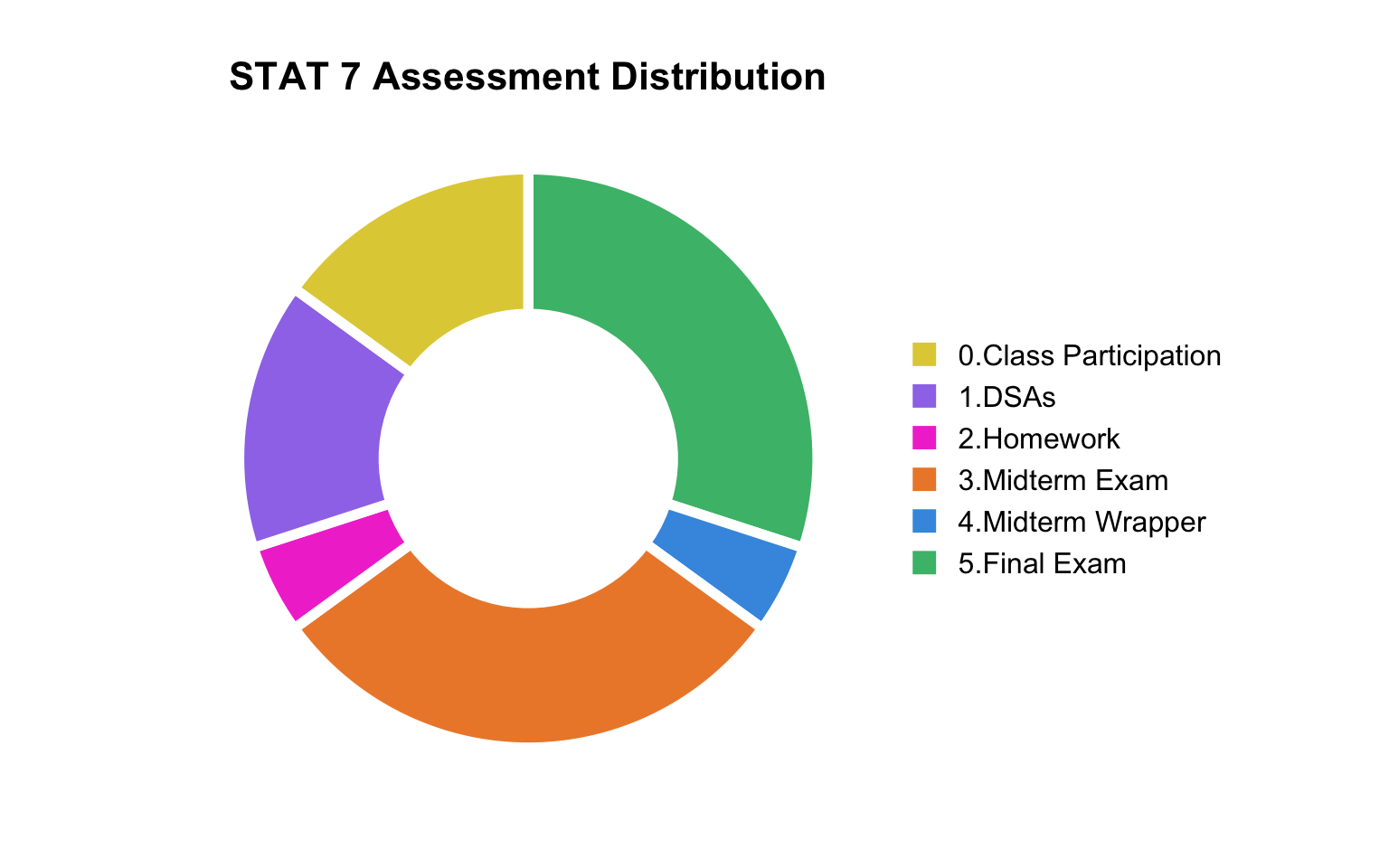
In-Class Work (30%)
Lecture Participation (15%)
- Attend at least 85% of lectures (19 total, excluding midterm review)
- Complete syllabus acknowledgment, Quiz 0, and all Canvas surveys
- Active participation via Poll Everywhere
- Points: 5 quizzes/surveys + 10 Poll Everywhere = 15 points
Discussion Section Activities (15%)
- 8 DSAs total completed in groups of 2
- Must be present in DS to receive credit
- Submit on paper (handwritten) at end of section
- TA collects and uploads to GradeScope
- Only 5 highest grades count
- Points: 3 points each × 5 = 15 points
Outside of Class (5%)
Homework (5%)
- 9 weekly assignments (assigned Friday, due next Friday)
- Submit via Canvas
- Must be solved by hand and scanned (typed answers = 0 points)
- Graded on completion (attempt all problems)
- Only 5 highest grades count
- Points: 1 point each × 5 = 5 points
Exams (65%)
Midterm Exam (30%)
- When: Week 5 (Thursday, February 5th) during class time
- Duration: 1.5 hours
- Coverage: First four weeks of material
- In person, on paper
Midterm Wrapper (5%)
- Reflective exercise completed after midterm is graded
- Review performance and instructor feedback
- Adapt future learning strategies
- Submit by hand via Canvas
Final Exam (30%)
- When: Wednesday, March 18th, 7:30-9:30 PM
- Location: Regular classroom
- Duration: 2 hours
- Comprehensive: All course topics
- In person, on paper
Grading Scale
| Letter | Score Range | Letter | Score Range |
|---|---|---|---|
| A+ | ≥ 99 | C+ | 70-74.99 |
| A | 95-98.99 | C | 65-69.99 |
| A- | 90-94.99 | C- | 60-64.99 |
| B+ | 85-89.99 | D | 50-59.99 |
| B | 80-84.99 | F | < 50 |
| B- | 75-79.99 | P/NP | ≥65 / <65 |
Grading Timeline
- DSA regrades: Within 1 week of grades being posted (via GradeScope)
- Final exam questions/regrades: By March 24th, 11:59 PM (via GradeScope)
- All grade questions: By March 24th, 11:59 PM
- Final grades posted: March 25th (no modifications after this date)
Attendance & Course Delivery
WarningThis is an In-Person Course
This course thrives on active participation and collaborative learning. Regular attendance at lectures and discussion sections is essential for your success.
All exams will be held in person to ensure fairness and academic integrity.
If you are unable to attend regularly this quarter, we encourage you to consider taking the course when you can fully engage with the learning community.
Flexibility Built Into Assessments
The flexibility outlined below is what’s available—no additional accommodations will be provided beyond what is listed here.
| Assignment | Total Opportunities | Flexibility | Weight |
|---|---|---|---|
| Lecture Participation | 19 lectures + 5 surveys | 85% attendance = full points | 15% |
| DS Activities | 8 DSAs (3 points each) | Only top 5 count | 15% |
| Homework | 8 HWs (1 point each) | Only top 5 count | 5% |
| Midterm & Final | In person, on paper | Extra credit points included | 60% |
| Midterm Wrapper | Submit via Canvas | Must be handwritten | 5% |
Expected Time Commitment
This is a 5-unit course requiring approximately:
- 3.25 hours: Lecture
- 1 hour: Discussion section
- 5 hours: Reading
- 5.75 hours: Homework
Total: ~15 hours per week
Weekly Schedule
| Week | Topics | Readings | Assignments |
|---|---|---|---|
| 0 | Intro to course + Slug Success workshop | Relevant reading, Section 1.1 | Module 0, set up all tech access |
| 1 | Introductions & Types of Data and Data Collection | Sections 1.2-1.5 | HW 1 |
| 2 | Descriptive Statistics & Basic Data Visualization | Sections 1.6-1.7, 2.1 | DSA 1, HW 2 |
| 3 | Probability and Random Variables | Sections 2.2-2.3, 3.1-3.4 | DSA 2, HW 3 |
| 4 | Random variables and sampling distributions | Sections 4.1-4.3 | DSA 3, HW 4 |
| 5 | Review & MIDTERM | DSA 4, Midterm (Thurs) | |
| 6 | Inference: CI and hypothesis tests (one/two means) | Sections 5.1-5.2 | Midterm wrapper, DSA 5, HW 5 |
| 7 | Power, Sample Size and Correlation | Sections 5.3-5.5 | DSA 6, HW 6 |
| 8 | Linear Regression and ANOVA | Sections 6.1-6.5 | DSA 7, HW 7 |
| 9 | Inference for categorical data | Sections 8.1-8.2 | DSA 8, HW 8 |
| 10 | Chi-square tests | Sections 8.3-8.4 | |
| Finals | FINAL EXAM: Wed 3/18, 7:30-9:30 PM |
Artificial Intelligence (AI) Policy
GenAI and Learning
To ensure you build critical thinking and problem-solving abilities, all graded assignments must reflect your own work. Using genAI tools (ChatGPT, Claude, etc.) for graded work prevents genuine skill development and constitutes academic misconduct.
Why This Matters
Working through problems yourself builds neural pathways and deepens understanding in ways that reading AI-generated solutions cannot replicate.
AI for Study Support
You’re welcome to use AI tools to:
- Create practice problems to test your understanding
- Ask for step-by-step explanations of concepts
- Generate alternative explanations if something doesn’t click
- Create variations of homework problems with different scenarios
Important Boundaries
- Solve practice problems independently first - AI won’t be available during exams!
- Never upload course materials to AI platforms (copyright issues)
- Remember AI can be wrong - always verify against course materials
- When in doubt, ask!
Academic Integrity
All members of the UCSC community benefit from an environment of trust, honesty, fairness, respect, and responsibility.
Academic Integrity Includes
- Reading the syllabus and asking questions about policies
- Following exam rules and using only permitted materials
- Keeping exam content confidential
- Proper citation of all sources
- Submitting your own original work
Academic Misconduct Includes
- Disclosing exam content during or after taking an exam
- Accessing exam materials without permission
- Copying/purchasing material submitted as your own
- Plagiarism, including uncited internet material
- Using genAI to complete graded work
- Using electronics during exams without permission
- Self-plagiarism (submitting work from another class)
Violations can result in: failing grades, permanent transcript notation, and/or dismissal
University Policies & Resources
Accessibility
UC Santa Cruz is committed to creating an accessible academic environment. If you require accommodations, contact the Disability Resource Center (DRC) at 831-459-2089 or drc@ucsc.edu.
If you’re already affiliated with DRC, request your Academic Access Letters. To discuss accommodations privately, schedule time during my office hours.
Religious Accommodation
If an academic requirement conflicts with religious observances, you may request reasonable accommodation. Discuss conflicts and requested accommodations with me early in the term.
Principles of Community
UCSC expressly prohibits unlawful discrimination, harassment, and bias. I am committed to providing a respectful, inclusive learning atmosphere. Please:
- Be open to others’ viewpoints
- Honor unique life experiences of colleagues
- Listen respectfully and communicate professionally
- Keep personal/professional discussions confidential
- Ground comments in course texts
Title IX/CARE Advisory
The Title IX Office protects community members from sex discrimination, sexual harassment, sexual violence, and gender-based harassment.
Confidential support:
- CARE Office: 831-502-2273
- CAPS: 831-459-2628
Reporting:
- Title IX Office: 831-459-2462
- UCPD: 831-459-2231 ext. 1
- Emergencies: 911
Student Services
Learn about student services at UCSC (Learning Support Services, Resource Centers, Slug Support) at the Campus Resources website or click the “Resources” button in Canvas.
Tutoring
Learning Support Services (LSS) provides tutoring for this class through STAT Study Hall—a drop-in space where tutors support multiple STAT courses.
Why attend? Students who attend weekly tend to earn higher final grades.
Visit the LSS website or check Tutor Hub for session times.
Student Feedback
At quarter’s end, you’ll complete a Student Experience of Teaching Survey (SETs). This anonymous feedback helps me improve the course for future students.
Questions? Reach out via Ed Discussion or office hours. Looking forward to a great quarter!