
STAT 17: Statistical Methods for Business and Economics
Fall 2025
Syllabus subject to change. First version: September 11th, 2025, Last edit on: 09/23
COURSE INFORMATION
Instructor: Marcela Alfaro Córdoba
Email: macordob@ucsc.edu
Students can address me as Professor Alfaro Córdoba, Dr. Alfaro Córdoba, or simply Marcela (pronounced [mahr-sahl-ah]). Please avoid calling me (or any of your female instructors) Miss or Ms.
Office Hours: - Tuesday 5:00 - 6:00 PM in person (after class, in the same classroom) - Other days online, by appointment: https://calendar.app.google/sGTU1qLwBmSvX6bh6
Class Times: Tuesday & Thursday 15:20 - 16:55
Location: Media Theater M110
Course Canvas: https://canvas.ucsc.edu/courses/85213
Course Description
This course introduces you to statistical methods commonly used in business and economics. We’ll cover the essentials in two main parts: first, you’ll learn descriptive methods, probability, random variables, expected values, and sampling techniques. In the second half, we’ll get into statistical inference, including estimation, confidence intervals, hypothesis testing, analyzing one- and two-sample problems, correlation, and simple linear regression. You’ll get hands-on experience with statistical calculations using Google Sheets in this course, while also learning STATA in the companion lab (STAT 17L). By the end of the quarter, you’ll be comfortable performing statistical analysis using both tools, giving you valuable skills for your future coursework and career.
Instructor Bio
I am an applied statistician with an interest in statistical applications to environmental and biological problems. I also work on Stats and Data Science Education. I’ve been teaching at UCSC since 2021, but I have more than 10 years of experience teaching probability and statistics. If you are curious about my projects, you can check my personal webpage: https://malfaro2.github.io/
Office hours: This is a space to talk to the instructor. You don’t need to be prepared to attend; you can show up with general or specific questions. You are also more than welcome to stop by if you want to talk about anything related to the class or even to a future career in Statistics or Data Science.
LEARNING OUTCOMES
By the end of the course, students should be able to:
- Produce appropriate graphical and numerical descriptive statistics for different types of data.
- Apply probability rules and concepts related to discrete and continuous random variables to answer questions within a business and economics context.
- Demonstrate understanding of (a) the development of point estimates for unknown population quantities based on appropriate sample quantities and (b) the process of deriving sampling distributions for point estimates.
- Demonstrate knowledge of the importance of the Central Limit Theorem (CLT) and its applications.
- Conduct and interpret a variety of hypothesis tests (and construct and interpret a variety of confidence intervals) to aid decision-making in a business and economics context.
- Use simple regression models to analyze the underlying relationships between the observed variables through hypothesis testing, confidence intervals, and predictions.
A more detailed list of learning outcomes can be found here: STAT17_LOs_Fall2025
REQUIRED MATERIALS, TEXTBOOKS AND TECHNOLOGY
Laptop or Desktop Computer
You will need a computer for homework, in-class activities, and discussion sections. You will not be able to complete most of the work on a mobile device. Students who need a laptop can make use of the library’s borrow program: https://library.ucsc.edu/services/computing/borrow-a-laptop
Technology
Personal computer with Zoom, Canvas, GradeScope, and Google Suite access. Zoom links will be posted in Canvas when necessary. An account on Poll Everywhere (please don’t pay for it, I’ll cover the cost for you).
Required Textbook
Introduction to Business Statistics Open Stax. 2nd edition.
https://openstax.org/details/books/introductory-business-statistics-2e
Lectures are designed to supplement the textbook reading, not substitute for it. Please make sure you have access to our textbook to complete your readings and homework.
Prerequisites
Prerequisite(s): Score of 300 or higher on the mathematics placement examination (MPE), or AM 3 or AM 11A or MATH 3 or MATH 11A. MATH 19A strongly recommended. Concurrent enrollment in STAT 17L is required.
COMMUNICATION
Questions, announcements, and requests: We will be available via email, but please expect a turnaround time of 2-3 days. Office hours or Ed Discussion are a more efficient way to contact us. Please don’t use Canvas messages, you will get an automatic response.
New to Ed Discussion? This guide can help: https://edstem.org/quickstart/ed-discussion.pdf
Contact priority: 1. Ed Discussion (see link on Canvas) ← best option, most efficient 2. Email (please leave this as the last option, not recommended for urgent matters)
Lectures: In person, mandatory attendance. They will be recorded, and posted at the end of the day.
ASSIGNMENTS & ASSESSMENT
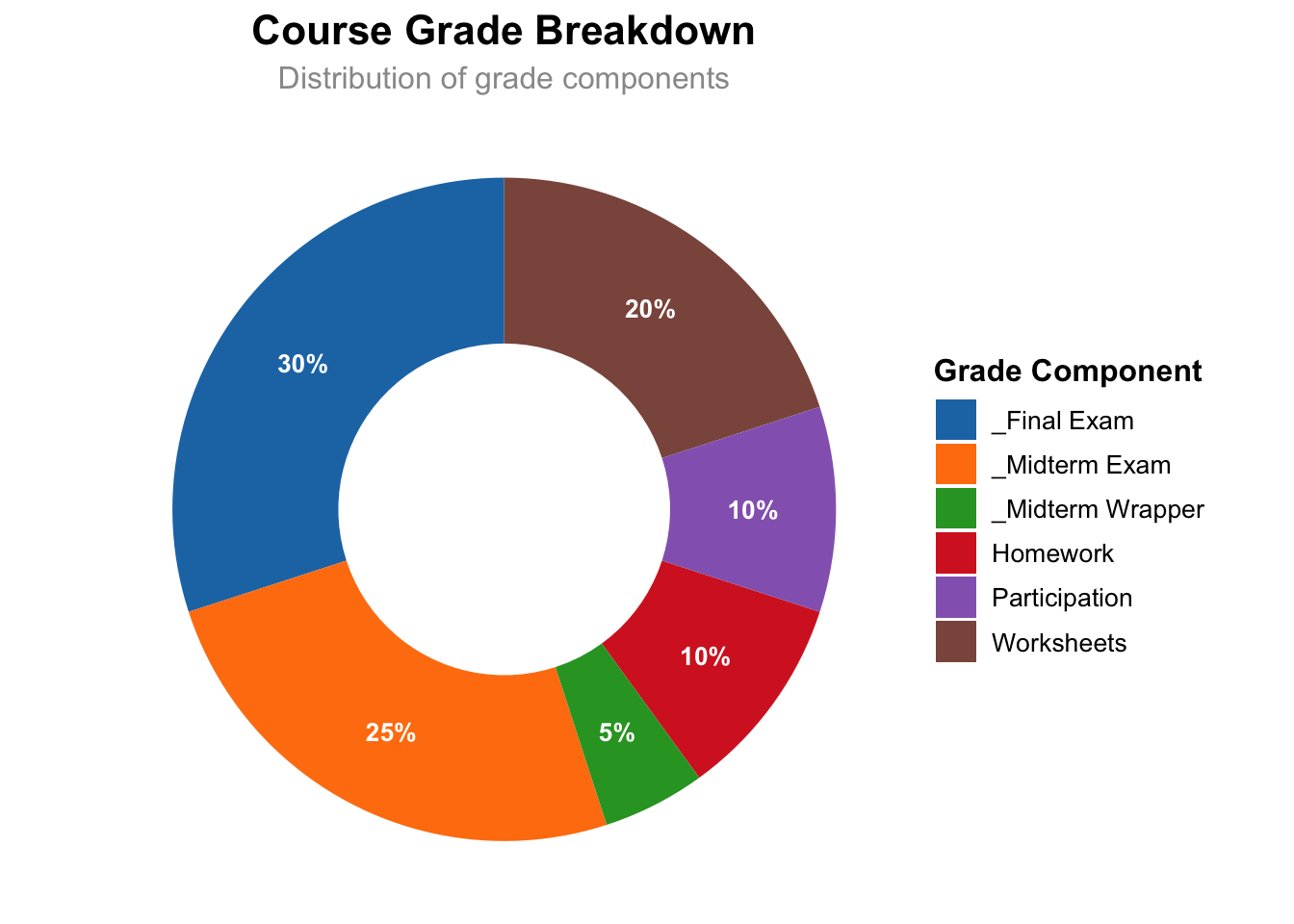
Assessment for the course consists of six components: participation, homework, worksheets on discussion sections, midterm exam, midterm exam wrapper, and final exam.
Participation: 10% Lecture attendance, surveys, extra credit, and SET completion.
Homework: 10% There will be 8 assignments via Canvas, checked by completeness, open one week from Friday to Friday. Late assignments will lose 2 points per day. The three lowest grades will be dropped. In homework, you will apply what you’ve learned during the lecture and discussion sections to complete exercises. The idea is that you read the chapter and complete the recommended exercises weekly. You may discuss homework assignments with other students; however, homework should be completed and submitted individually. Please use office hours in case you don’t understand something; we will be happy to walk you through the exercises. These problems will be very similar to the ones included in your exams.
Worksheets on Discussion Sections: 20% There will be 8 assignments via GradeScope, one group assessment per section, due at the end of that day. Attending sections is mandatory to get points. The three lowest grades will be dropped. Each TA will have assessments (WS) in their discussion sessions for you to complete in groups. You can work with the same group every week or switch if you prefer. If you cannot finish the work during the session, the space will be open until the end of that day. Note that attending the discussion sections in person is mandatory to get credit for your work, your TA will be the one in charge of taking attendance. If you submit your WS but we don’t have a record of your attendance or a token to justify your absence, you will not get credit for your work.
Midterm Exam: 25% The midterm exam is scheduled for October 30th, 2025 during class time. In person, Thursday, October 30th during class time. If you cannot make it because of illness, you will be given one makeup opportunity one week after the original date. The exam will include extra points. We will have two in-person exams. They will include questions from WSs and homework. You should bring a pencil (or pen), calculator and a photo ID to the tests.
Midterm Exam wrapper: 5% Due a week after midterm grades are posted. Please note that this assignment doesn’t have second chances to submit.
Final Exam: 30% In person, Wednesday, December 10th, from 4 PM to 7 PM in our usual classroom. The exam will include extra points.
Grading Scale
| Letter | Score | Letter | Score |
|---|---|---|---|
| A+ | x ≥ 99 | C+ | 70 ≤ x < 74.99 |
| A | 95 ≤ x < 98.99 | C | 65 ≤ x < 69.99 |
| A- | 90 ≤ x < 94.99 | C- | 60 ≤ x < 64.99 |
| B+ | 85 ≤ x < 89.99 | D | 50 ≤ x < 59.99 |
| B | 80 ≤ x < 84.99 | F | x < 50 |
| B- | 75 ≤ x < 79.99 | P/NP | x ≥ 65 / x < 65 |
Grades Timeline
- Deadline for worksheet regrades (via GradeScope): one week after grades are posted
- Deadline for final exam questions/regrades (via GradeScope): December 15th, 11:59 PM
- Any other questions about grades are accepted before December 16th, 11:59 PM
- Grades will be posted on the system early on December 17th. I cannot modify any grades after that.
The graders will provide direct comments and feedback on the discussion section assignments. Homework will be graded by completion, but you can always use office hours to clarify any answers. Exams will be graded by the TAs and the instructor.
COURSE WEEKLY SCHEDULE
This schedule may change during the quarter. Please consult the class webpage for a more updated version.
| Week | Topics | Textbook Chapter | Evaluations (HW + WS + others) |
|---|---|---|---|
| 0 | What is statistics? Road map for the course + syllabus / LSS workshop | Survey 1 | |
| 1 | Sampling and Data | 1 | WS 1 |
| 1 | Descriptive Statistics | 2 | assign HW1 - Ch1-2 |
| 2 | Descriptive Statistics | 2 | WS 2 |
| 2 | Probability Topics | 3 | assign HW2 - Ch2-3 |
| 3 | Probability Topics + Review | 3 | WS 3 |
| 3 | Discrete Random Variables | 4 | assign HW3 - Ch3-4 |
| 4 | Discrete and Continuous Random Variables | 4-5 | WS 4 |
| 4 | Continuous Random Variables | 5 | assign HW4 - Ch5-6 |
| 5 | Normal Distribution + Review | 6 | |
| 5 | Midterm Exam | assign HW5 Ch7-8 | |
| 6 | CLT + Confidence intervals | 7-8 | WS 5 |
| 6 | Hypothesis testing with one sample | 9 | assign HW6 Ch9-10 |
| 7 | No Class - Veterans Day | WS 6 + Exam Wrapper + Survey 2 | |
| 7 | Hypothesis testing with two samples | 10 | assign HW7 Ch11-12 |
| 8 | The Chi-Square Distribution | 11 | WS 7 |
| 8 | F Distribution and One-Way ANOVA | 12 | assign Practice for the final Ch12-13 (HW8) |
| 9 | Linear Regression and correlation | 13 | WS 8 |
| 9 | No Class - Thanksgiving Holiday | ||
| 10 | Linear Regression and correlation | 13 | |
| 10 | Review all |
Final Exam Date: Wednesday, December 10th, from 4 PM to 7 PM in our usual classroom.
Discussion Sections
First day of DS: Friday, September 26th
| Section | Day | Time | Location | TA |
|---|---|---|---|---|
| STAT 17-01A | Monday | 8:00 AM - 9:05 AM | Earth & Marine B210 | TA 2 |
| STAT 17-01B | Monday | 9:20 AM - 10:25 AM | Porter Academic 144 | TA 2 |
| STAT 17-01C | Tuesday | 7:10 PM - 8:15 PM | Earth & Marine B210 | TA 3 |
| STAT 17-01D | Friday | 2:40 PM - 3:45 PM | Physical Sciences 140 | TA 1 |
| STAT 17-01E | Friday | 4:00 PM - 5:05 PM | Physical Sciences 140 | TA 1 |
| STAT 17-01F | Thursday | 8:00 AM - 9:05 AM | Physical Sciences 110 | TA 3 |
TEACHING TEAM INFORMATION
| Name | Discussion Sections | Office Hours |
|---|---|---|
| TA 1: Samantha Zhu | D, E | Mon 11:30a-12:30p (remote), Fri 1:00p-2:00p (Engineering 2, by the elevator on the 5th floor) |
| TA 2: Seokjun Choi | A, B | Mon 10:25am-10:55am (in person, Porter Acad D250), Thur 6:00pm-7:00pm (remote) |
| TA 3: Xiao Zhang | C, F | Tues: 3:30pm-4:30pm (in person at Engineering 2 510), Wed: 11:00 AM -12:00 PM (remote) |
LSS Tutor: STAT 17, 7, and 5 will have a study hall for tutoring this quarter. To get to know the team, how it works and how to sign up, please click here: https://learningsupport.ucsc.edu/programs/study-hall/
The STAT Study Hall Tutor/s for your class: - Sadhika Agrawal (she/her) sagraw17@ucsc.edu - Sharry Eydel (she/her) seydel@ucsc.edu
Readers: Misha Tran Burton, Ingrid Eliza Fowler-White, and Sadhika Agrawal
STUDENT HOURS FOR CLASS
This is a 5-unit course. It will require 3.25 hours of lecture, 5 hours of reading, 1 hour of section, and 5.75 hours of homework per week.
STUDENT FEEDBACK
At the end of the quarter you will be asked to complete a Student Experience of Teaching Survey (SETs) for this course. SETs provide you with an opportunity to give me honest and constructive feedback on your learning experience. I use this anonymous feedback to help me make modifications that can help future students learn more effectively. More info here: https://its.ucsc.edu/sets/index.html
TIPS TO SUCCEED IN THIS CLASS
- Stay on top of weekly readings from the textbook – they’re your foundation for understanding new concepts.
- Show up and engage actively in lectures and discussions. Your participation helps you learn and helps your classmates too!
- Read the syllabus carefully and make sure you understand how you’ll be evaluated throughout the course.
- Complete homework problems and worksheets weekly, consistent practice makes exam prep much easier. Find a study group and stick with it; learning together makes everything more manageable.
- Build your formula sheet each week by adding new theorems, formulas, and key properties from each class session.
- Ask questions when you’re stuck! Use office hours with TAs and your instructor – no question is too small, and getting help early prevents bigger problems later.
TUTORING
There is tutoring available for this class, provided by Learning Support Services (LSS)! Learning Support Services Tutors are an important part of the teaching team and are here to help you be successful. Tutoring is for everyone and open to all students in class to get extra practice on the things you already know or the things you want to know better. Your tutors are undergraduate students who took the class, did well, and received extensive training on how to help you learn!
This quarter, LSS is supporting this course with STAT Study Hall. The tutors listed above will be supporting multiple courses and sections in a drop-in, low stakes space where students can work together or receive individual tutoring. Why attend? Students who attend sessions weekly tend to earn a higher final grade than students who do not participate. Ask your tutor for more information about session times, visit the LSS website, or view your tutoring schedule on Tutor Hub.
ATTENDANCE AND COURSE DELIVERY POLICY
In-Person Learning Community
This course thrives on active participation and collaborative learning. To get the most out of our time together, regular attendance at lectures and discussion sections is essential for your success.
Exams
All exams will be held in person to ensure fairness and academic integrity. This allows us to provide the best testing environment for all students.
Course Format
We’ve designed this as an interactive, in-person experience that builds on daily discussions and activities. If you’re unable to attend regularly this quarter, we’d encourage you to consider taking the course when you can fully engage with the learning community.
Flexible Attendance Support
We understand that life happens! Each student receives 3 absence tokens per quarter that you can use for lectures or discussion sections when needed. Simply complete this form by the end of the day for any class you’ll miss, and there’s no academic penalty: https://forms.gle/5hDFU6KnNjKKprno8
Missing lectures/discussion sections
We know there are always going to be difficulties, so we want to provide a way for you to manage your absences. We provide 3 tokens per student per quarter. This means that you can skip 3 lectures or discussion sections, without consequences. What do you need to do? You need to fill out this form before the end of the day of the class or the discussion section you are missing: https://forms.gle/5hDFU6KnNjKKprno8
ARTIFICIAL INTELLIGENCE (AI) POLICY
GenAI Tools and Learning
We want to support your genuine understanding and skill development in this course. To ensure you’re building the critical thinking and problem-solving abilities that will serve you beyond this class, all graded assignments (homework, worksheets, and exams) should reflect your own work and understanding. Using genAI tools like ChatGPT, Claude, or other language models for graded work would prevent you from developing these essential skills and would be considered academic misconduct.
Why This Matters
When you work through problems yourself, you’re building neural pathways and deepening your understanding in ways that simply reading AI-generated solutions cannot replicate. These assignments are designed as learning opportunities, not just evaluation checkpoints.
AI for Study Support
You’re welcome to use AI tools to create practice problems or generate study materials to help you explore concepts from different angles. This can be a great way to test your understanding! Just remember that AI can sometimes provide incorrect information, so always double-check against your course materials and use AI-generated content as a supplement to—not a replacement for—your assigned readings and exercises. Some tips:
- Smart usage boundaries: Use AI to understand concepts and check your approach, but always solve practice problems independently first. Remember: AI won’t be available during exams, so build your own problem-solving confidence!
- Use AI as a teaching assistant: Ask for step-by-step explanations of concepts, alternative explanations if something doesn’t click, and connections to previous topics you’ve studied.
- Practice problem generation: Have AI create variations of homework problems with different numbers or scenarios to test your understanding.
- Protect class materials: Do not upload or submit course materials (textbook excerpts, handouts, assignments) to AI platforms, as this creates copyright and author rights issues. Instead, ask general questions about concepts or create your own examples for AI to work with.
When in Doubt, Ask: If you’re ever uncertain about whether a particular use of AI would be appropriate for your learning goals, please reach out. We’re here to help you succeed while ensuring you’re genuinely mastering the material.
ACCESSIBILITY
UC Santa Cruz is committed to creating an academic environment that supports its diverse student body. If you are disabled and require accommodations to achieve equal access in this course, please contact the Disability Resource Center (DRC) at 831-459-2089 or drc@ucsc.edu. If you are already affiliated with the DRC, please be sure to request your Academic Access Letters. If you are not sure whether you are eligible for accommodations, please contact the DRC to schedule an evaluation. If you would like to discuss your accommodations with me, or if you have any other concerns related to accessibility in this course, please request to meet privately with me during my office hours or by appointment so I can ensure your privacy during our conversation.
ACADEMIC INTEGRITY
All members of the UCSC community benefit from an environment of trust, honesty, fairness, respect, and responsibility. You are expected to present your own work and acknowledge the work of others in order to preserve the integrity of scholarship, and the value of the degrees you and your peers are working so hard to earn.
Academic integrity includes, but is not limited to, the following:
- Being transparent and forthright in your academic work
- Reading the syllabus
- Asking questions about this academic integrity policy if you don’t understand it
- Following exam rules
- Using only permitted materials during an exam
- Viewing exam materials only when permitted by your instructor
- Keeping what you know about an exam to yourself
- Incorporating proper citation of all sources of information
- Disclosing the use of any editing software or grammar tools
- Submitting your own original work
Academic misconduct includes, but is not limited to, the following:
- Disclosing exam content during or after you have taken an exam
- Accessing exam materials without permission
- Copying/purchasing any material from another student, or from another source, that is submitted for grading as your own
- Plagiarism, including use of Internet material without proper citation
- Submitting work that was produced in whole or in part by generative artificial intelligence
- Failing to properly cite external sources when their use is permitted
- Using cell phones or other electronics to obtain outside information during an exam without explicit permission from the instructor
- Submitting your own work in one class that was completed for another class (self-plagiarism) without prior permission from the instructor
Violations of the academic integrity policy can result in a permanent notation on your transcript, a failing grade on an assignment or in the course, and/or dismissal from the university. For the full policy and formal resolution procedures for academic misconduct, please refer to the Academic Integrity Office and Academic Integrity Policy pages at the Division of Undergraduate Education.
STUDENT SUPPORT SERVICES
To learn about the many student services offered at UCSC—such as Learning Support Services (LSS), Resource Centers, or Slug Support—I encourage you to visit the Campus Resources website or click on the “Resources” button (a slug in a heart) at the bottom of the navigation ribbon on the left side of our Canvas page.
RELIGIOUS ACCOMMODATION
UC Santa Cruz welcomes diversity of religious beliefs and practices, recognizing the contributions differing experiences and viewpoints can bring to the community. There may be times when an academic requirement conflicts with religious observances and practices. If that happens, students may request reasonable accommodation for religious practices. The instructor will review the situation in an effort to provide a reasonable accommodation without penalty. You should first discuss the conflict and your requested accommodation with your instructor early in the term. You or your instructor may also seek assistance from the Dean of Students office.
PRINCIPLES OF COMMUNITY
The University of California, Santa Cruz expressly prohibits students from engaging in conduct constituting unlawful discrimination, harassment or bias. I am committed to providing an atmosphere for learning that respects diversity and supports inclusivity. We need to work together to build this community of learning. I ask all members of this class to:
- Be open to and interested in the views of others
- Consider the possibility that your views may change over the course of the term
- Be aware that this course asks you to reconsider some “common sense” notions you may hold
- Honor the unique life experiences of your colleagues
- Appreciate the opportunity that we have to learn from each other
- Listen to each other’s opinions and communicate in a respectful manner
- Keep confidential discussions that the community has of a personal (or professional) nature
- Ground your comments in the texts we are studying. Refer frequently to the texts and make them the focus of your questions, comments, and arguments. This is the single most effective way to ensure respectful discussion and to create a space where we are all learning together.
TITLE IX/CARE ADVISORY
The Title IX Office is committed to fostering a campus climate in which members of our community are protected from all forms of sex discrimination, including sexual harassment, sexual violence, and gender-based harassment and discrimination. Title IX is a neutral office committed to safety, fairness, trauma-informed practices, and due process. Title IX prohibits gender discrimination, including sexual harassment, domestic and dating violence, sexual assault, and stalking. If you have experienced sexual harassment or sexual violence, you can receive confidential support and advocacy at the Campus Advocacy Resources & Education (CARE) Office by calling (831) 502-2273. In addition, Counseling & Psychological Services (CAPS) can provide confidential counseling support, (831) 459-2628. You can also report gender discrimination directly to the University’s Title IX Office, (831) 459-2462. Reports to law enforcement can be made to UCPD, (831) 459-2231 ext. 1. For emergencies call 911.
STUDENT SERVICES
To learn about the many student services offered at UCSC—such as Learning Support Services (LSS), Resource Centers, or Slug Support—I encourage you to visit the Campus Resources website or click on the “Resources” button (a slug in a heart) at the bottom of the navigation ribbon on the left side of our Canvas page.
This syllabus is subject to change. Any changes will be announced in class and posted on Ed Discussion.