Open and Responsible Research
Integrity, FAIR Principles & Ethical Data Use
2026-04-01
This Session
10:30 – 11:30 (60 minutes)
- Why open science now? Connecting to the bigger picture
- Responsible conduct of research (RCR)
- The reproducibility crisis
- FAIR data principles
- Ethical data use — bias, harm, and accountability
- 🗣️ Case-based group discussion
Note
The goal is not compliance — it is fostering ethical excellence.
We will also think about where GenAI enters these conversations and what new responsibilities that creates.
Connecting to This Morning’s Framing
This session follows “Why Open Science Now?” — funder mandates, the reproducibility crisis, and open pipelines.
Session 1 (Author Carpentry) asked:
How do I share my outputs openly and correctly?
→ OA routes, licensing, ORCIDs, author rights
This session asks:
How do I conduct and share research responsibly?
→ Integrity, FAIR data, ethical use, real consequences
Important
Openness without responsibility is insufficient.
Responsibility without openness is increasingly untenable.
Responsible Conduct of Research (RCR)
Being a responsible researcher goes beyond technical competence.
As knowledge producers, educators, and recipients of public funds, researchers carry additional obligations:
Key ethical principles:
- Beneficence (do good)
- Non-maleficence (cause no harm)
- Accountability
- Transparency
- Care and equity
- Collegiality
RCR covers:
- Research misconduct
- Data management practices
- Protection of human subjects
- Conflicts of interest
- Peer review integrity
- Mentor/trainee relationships
- Authorship and publications
- Collaborative research
RCR is a Community, Not Just an Individual, Concern
A single bad actor does not just harm their own work —
they damage trust in the entire research community.
RCR is not only about avoiding misconduct. It is about actively fostering a culture of ethical excellence.
The Reproducibility Crisis
A 2016 Nature survey of 1,576 researchers found that more than 70% had failed to reproduce another researcher’s experiment, and more than 50% had failed to reproduce their own.
Root causes identified:
| Cause | What it means in practice |
|---|---|
| Variability in analysis and methodology | Same data, different choices, different conclusions |
| Incentives toward publication over reproducibility | Journals reward novelty, not replication |
| Lack of transparency and data access | Can’t reproduce what you can’t see |
Same Data, Different Conclusions
Twenty-nine independent research teams analyzed the same dataset to answer the same question.
They reached widely different conclusions — depending on their analytical choices.
Tip
Open science practices that address this directly:
- Pre-registration (commit to your analysis plan before seeing results)
- Sharing code alongside publications
- Sharing raw data so others can verify and recheck
A Real Consequence: The Wakefield Case
In 1998, Andrew Wakefield and colleagues published a study in The Lancet (n=12) claiming a link between the MMR vaccine and autism.
The paper was later found to involve data manipulation and ethical violations and was retracted.
What happened:
- MMR vaccination rates dropped significantly in the UK
- Measles outbreaks followed in communities with lowered vaccine uptake
- The damage to public trust in vaccines persists decades later
Important
This is not a historical curiosity. Falsified or poorly conducted research with wide media reach can have lasting public health consequences — and the digital age amplifies spread faster than corrections can follow.
FAIR Data Principles
FAIR — a framework for making research data maximally useful.
| Principle | What it means in practice |
|---|---|
| Findable | Data has a persistent identifier (DOI); rich metadata; indexed in a searchable resource |
| Accessible | Data (or at least metadata) retrievable by standard protocols; access conditions are clear |
| Interoperable | Uses community standards and controlled vocabularies; links to other datasets |
| Reusable | Clear license; documented provenance; meets community quality standards |
Note
FAIR ≠ Open. Sensitive data can be FAIR with restricted access — as long as the conditions for access are clearly described.
FAIR in Practice: What Does It Actually Require?
Think through your own research data pipeline:
Common gaps:
- Data lives on a personal laptop with no backup
- Methods section says “data available on request” — but the PI left
- Column headers like
x1,x2,var3— no codebook - Analysis script exists but only runs on one machine
- License unclear or absent
Quick wins:
- Deposit in a domain repository or Zenodo
- Write a README with variable definitions
- Assign a CC0 or CC BY license to your dataset
- Share analysis code on GitHub with a DOI via Zenodo
- Use ORCID to link data to your identity
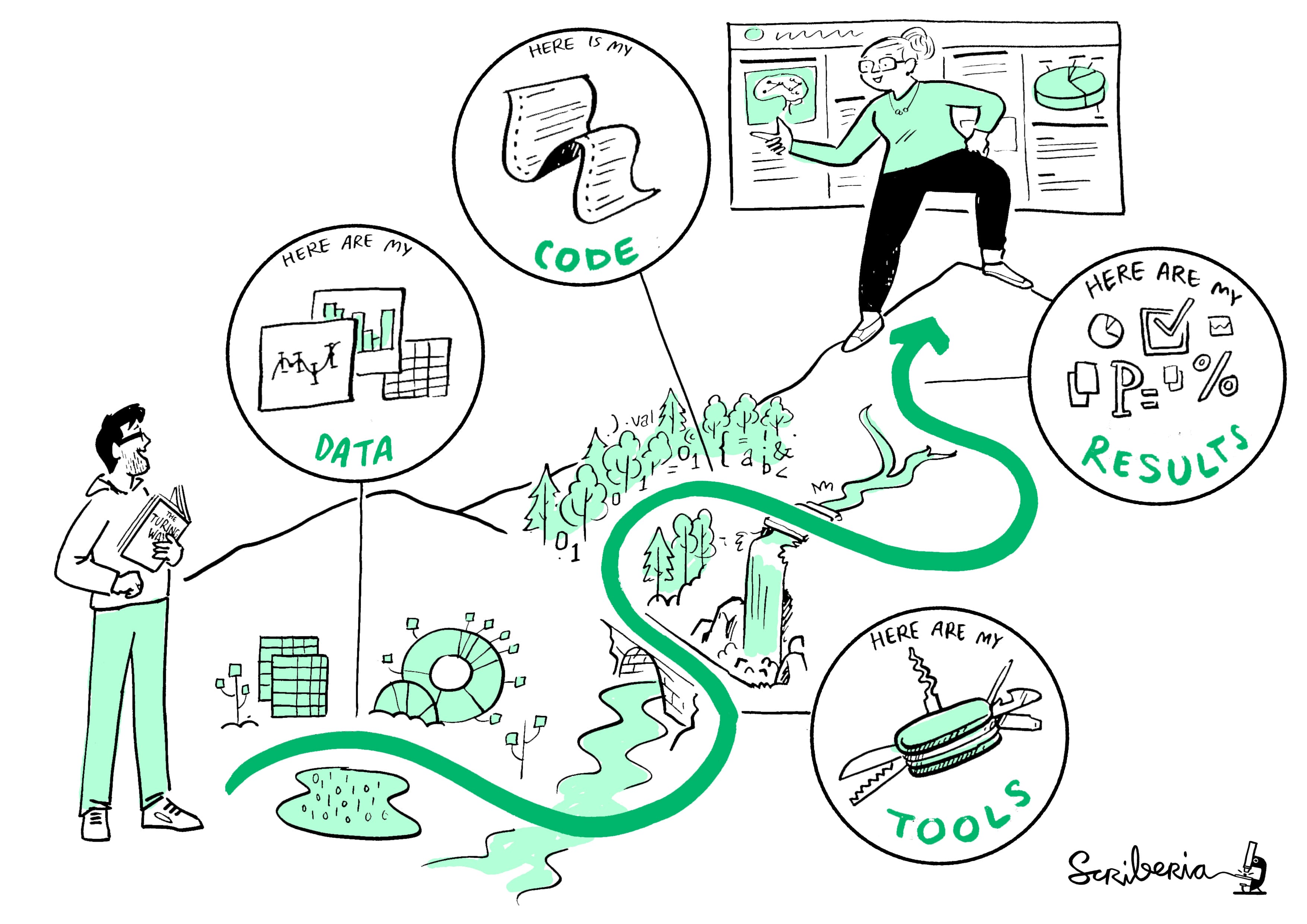
Openness Throughout the Research Lifecycle
https://book.the-turing-way.org/build/reproducibility-574764974583b6582d0a7a1b5c5c8316.jpg
Open practices map onto every stage of the research pipeline — not just the publication at the end.
Ethical Data Use: Where Responsibility Extends
Researchers increasingly work with large datasets, machine learning models, and tools that have real-world effects on people.
Ethical responsibilities extend to:
- Who collected the data, how, and with whose consent
- Whether the dataset is representative of the people it will affect
- What decisions will be made based on your analysis
- Whether you are perpetuating or interrogating existing inequities
Warning
You are not ethically neutral just because you are working with secondary data or a pre-trained model. The choice to use a tool or dataset is itself a choice with ethical implications.
Algorithmic Bias: A Concrete Example
Research has shown that widely deployed healthcare algorithms systematically underestimated the severity of illness in Black patients because they used healthcare cost as a proxy for health need — and Black patients historically received less care for the same conditions.
The algorithm was not programmed to be racist. But it was trained on data that reflected existing inequities — and it amplified them at scale.
The pattern appears across domains:
- Criminal justice risk scores (COMPAS — racial disparities in false positive rates)
- Facial recognition (higher error rates for darker-skinned women) see here
- Job advertising algorithms (women shown fewer ads for high-paid roles, among other biases. See here)
Tip
The question to ask is not only “is this model accurate?” but “accurate for whom, and at whose expense?”
What Causes Algorithmic Bias?
| Source | Example |
|---|---|
| Biased training data | Historical data reflects past discrimination |
| Unrepresentative datasets | Training set underrepresents certain groups |
| Poorly chosen features | Proxy variables that correlate with protected characteristics |
| Feedback loops | Predictions shape future data, reinforcing patterns |
| Lack of transparency | No way to audit where bias entered |
| Accuracy over fairness | Good average accuracy masks harms to subgroups |
Where Does GenAI Enter This?
Generative AI tools are trained on large datasets with the same representational problems — and they introduce new ones.
Documented concerns:
- LLMs encode and reproduce social biases present in training data
- GenAI can generate plausible-sounding but false citations and facts
- Outputs can differ significantly by language, region, or cultural context
- Use without disclosure violates research integrity norms
Using GenAI responsibly in research:
- Treat outputs as drafts — verify every factual claim
- Disclose use in methods or acknowledgments
- Be aware of what the tool cannot know (recent data, your context)
- Do not use GenAI for peer review content
- Consider data privacy before inputting sensitive data
Note
GenAI is a tool — the same ethical frameworks apply: transparency, accountability, non-maleficence. The researcher remains responsible.
🗣️ Case Discussion Activity
~20 minutes | Groups of 3–4
Each group takes one case. Discuss the questions, then share a 2-minute summary with the room.
Case A — The Reproducibility Problem
A research team publishes a high-profile study on cancer treatment outcomes. The paper is shared widely in the media. Six months later, another team cannot reproduce the results — the original team declines to share the underlying dataset, citing a future publication.
Discuss:
- What ethical principles are in tension here?
- What should the journal have required before publication?
- If you were on the original team, what would you do?
- How would pre-registration and open data policies have changed this situation?
- Could genAI help to reproduce the results?
Tip
Consider: Who is harmed when findings cannot be verified? Who benefits from delay?
Case B — FAIR in the Real World
A graduate student finishes their dissertation and graduates. Their dataset — three years of fieldwork — sits on a university server with a folder called final_FINAL_v3_USE_THIS. There is no codebook, no README, no license. The supervisor has retired. The university’s data policy says data should be retained for 10 years but gives no guidance on format or access.
Discuss:
- Which FAIR principles are violated here — and how?
- Who bears responsibility: the student, the supervisor, the institution?
- What would a FAIR-compliant version of this research process look like from the start?
- How would you approach this differently in your own work?
- Could genAI help to reconstruct the data?
Tip
Consider: Data management planning is not a bureaucratic checkbox — it is part of the research.
Case C — Bias and Accountability
A hospital deploys an AI-based triage tool that predicts which patients are at high risk and should be seen by a specialist. The tool was validated on data from a large academic medical center. A community health clinic begins using it. Nurses notice that the tool consistently flags fewer Black and Indigenous patients as high risk — even when their symptoms are severe.
Discuss:
- How might this bias have entered the system?
- Who is responsible — the tool’s developers, the hospital that adopted it, the clinicians using it?
- What should happen next? Who should be involved in that decision?
- What parallels exist in data science research you are familiar with?
- Could genAI help to correct the bias?
Tip
Consider: Adopting a tool is not ethically neutral. Using a tool = endorsing its assumptions about the world.
Case D — GenAI and Research Integrity
A researcher uses a large language model to conduct a literature review for a grant proposal. The model produces a well-organized summary with 18 citations. The researcher submits the proposal. Three of the citations do not exist. Two others exist but say the opposite of what was claimed. The proposal is funded. The false citations end up in the published paper’s introduction.
Discuss:
- At what point did the ethical failure occur?
- What responsibility does the researcher have, given the tool’s limitations?
- What disclosure practices should have been in place?
- How do you currently verify AI-generated content in your own work?
Tip
GenAI does not know what it does not know — and it does not tell you when it is guessing.
Key Takeaways
- RCR is not about avoiding violations — it is about actively building a culture of ethical excellence
- The reproducibility crisis has structural causes: incentives, transparency, and access to data and methods
- FAIR data is achievable with modest effort and pays dividends for your own future self as much as for others
- Algorithmic and data bias are not accidental — they reflect the choices made at every step of a pipeline
- GenAI is a useful tool, but it shifts responsibility toward the researcher, not away from them — transparency and verification are non-negotiable
- Open science is not a single act — it is a commitment that runs through the entire research process
Resources to Keep
| Resource | What it’s for |
|---|---|
| sherpa.ac.uk/romeo | Journal OA and self-archiving policies |
| orcid.org | Researcher persistent identifier |
| zenodo.org | Free data and code repository with DOIs |
| osf.io | Pre-registration, open materials, preprints |
| re3data.org | Find a domain-specific data repository |
| creativecommons.org/choose | Choose the right license |
| fosteropenscience.eu | Open science training materials |
| acm.org/code-of-ethics | Professional code of conduct (computing) |
Closing Thought
“Open Science is both a cultural movement and a set of individual research decisions. There is no ‘hard and fast’ rule — openness must work for you within your specific work context and your daily challenges.
But openness must work for you — because freeloading on an open ecosystem while contributing nothing back to it is its own kind of ethical problem.”
Note
The goal is not perfection from day one.
The goal is a commitment to doing a little better, more transparently, at every step.

CODATA-RDA Data Schools | malfaro2.github.io/codata_rda