Scatterplots, Correlation & Linear Regression
Week 8
🐧 Penguins & Body Size
A question from evolutionary biology:
Can we predict how heavy a penguin is just by measuring its flipper?
Researchers at Palmer Station, Antarctica measured 344 penguins across three species:
- Flipper length (mm)
- Body mass (g)
- Bill length and depth (mm)
- Species, island, sex
Today we’ll use this dataset to understand how two numerical variables relate — and how to use one to predict the other.
The Data: One Snapshot
A random sample of 6 penguins from the dataset:
| 191 |
4150 |
| 190 |
3400 |
| 230 |
5700 |
| 190 |
3700 |
| 209 |
4600 |
| 190 |
4250 |
Just looking at numbers is hard. We need a visualization.
Review: The Scatterplot
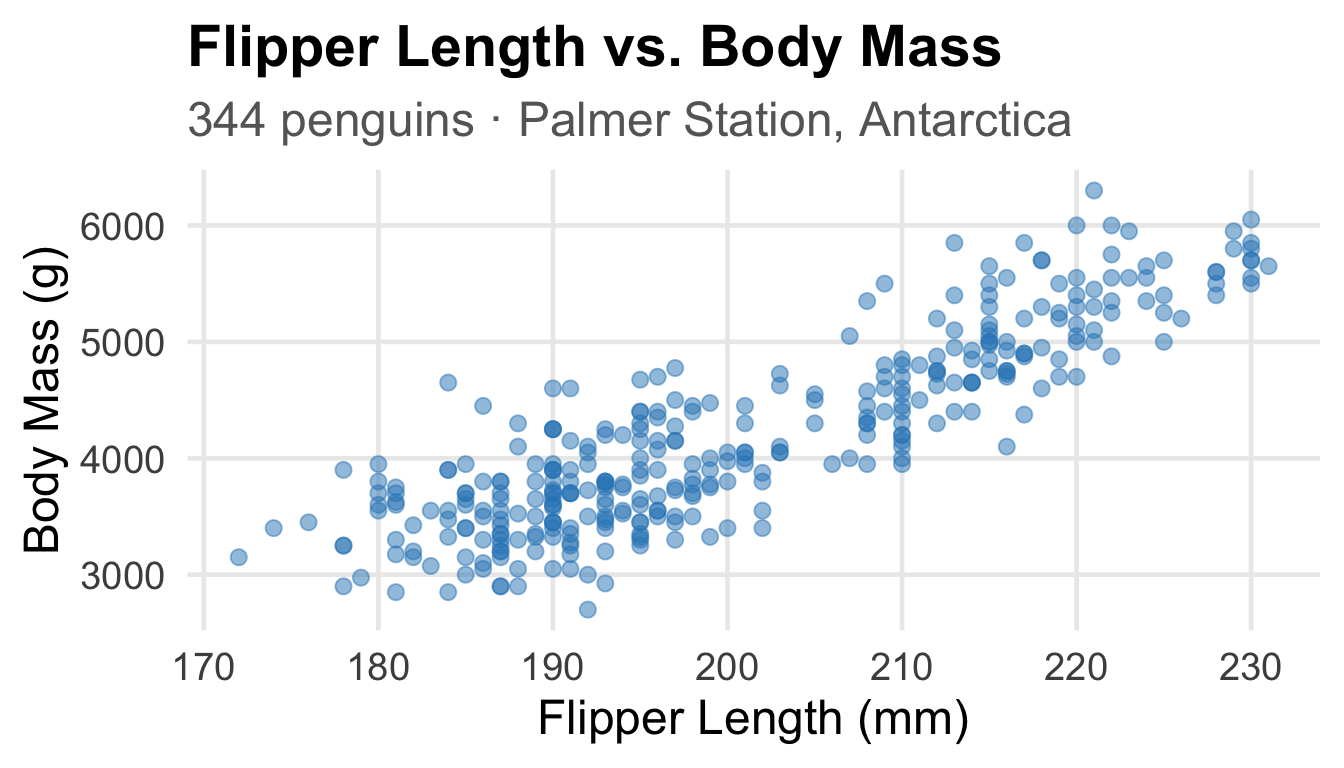
A scatterplot displays the relationship between two numerical variables.
- Each point = one observation (one penguin)
- x-axis = explanatory variable (flipper length)
- y-axis = response variable (body mass)
![]()
What to Look for in a Scatterplot
When describing a scatterplot, always comment on:
1. Direction — Does the relationship go up or down?
As flipper length increases, body mass tends to increase (positive)
2. Form — Is the pattern linear or curved?
The relationship appears roughly linear
3. Strength — How tightly do the points cluster around the pattern?
Points cluster fairly closely → moderately strong
4. Outliers — Any unusual points?
A few points fall away from the main trend
Think-Pair-Share #1
[Poll Everywhere — respond now!]
Look at this scatterplot description:
“As daily average temperature increases, hot chocolate sales decrease. The relationship is fairly linear and strong, with one outlier on a very cold day.”
Discuss with your neighbor (2 min):
- What is the direction, form, and strength?
- Which is the explanatory variable? Which is the response variable?
- Can we conclude that cold weather causes people to buy more hot chocolate? Why or why not?
→ Report your answer to Q3 on Poll Everywhere
Review: Correlation
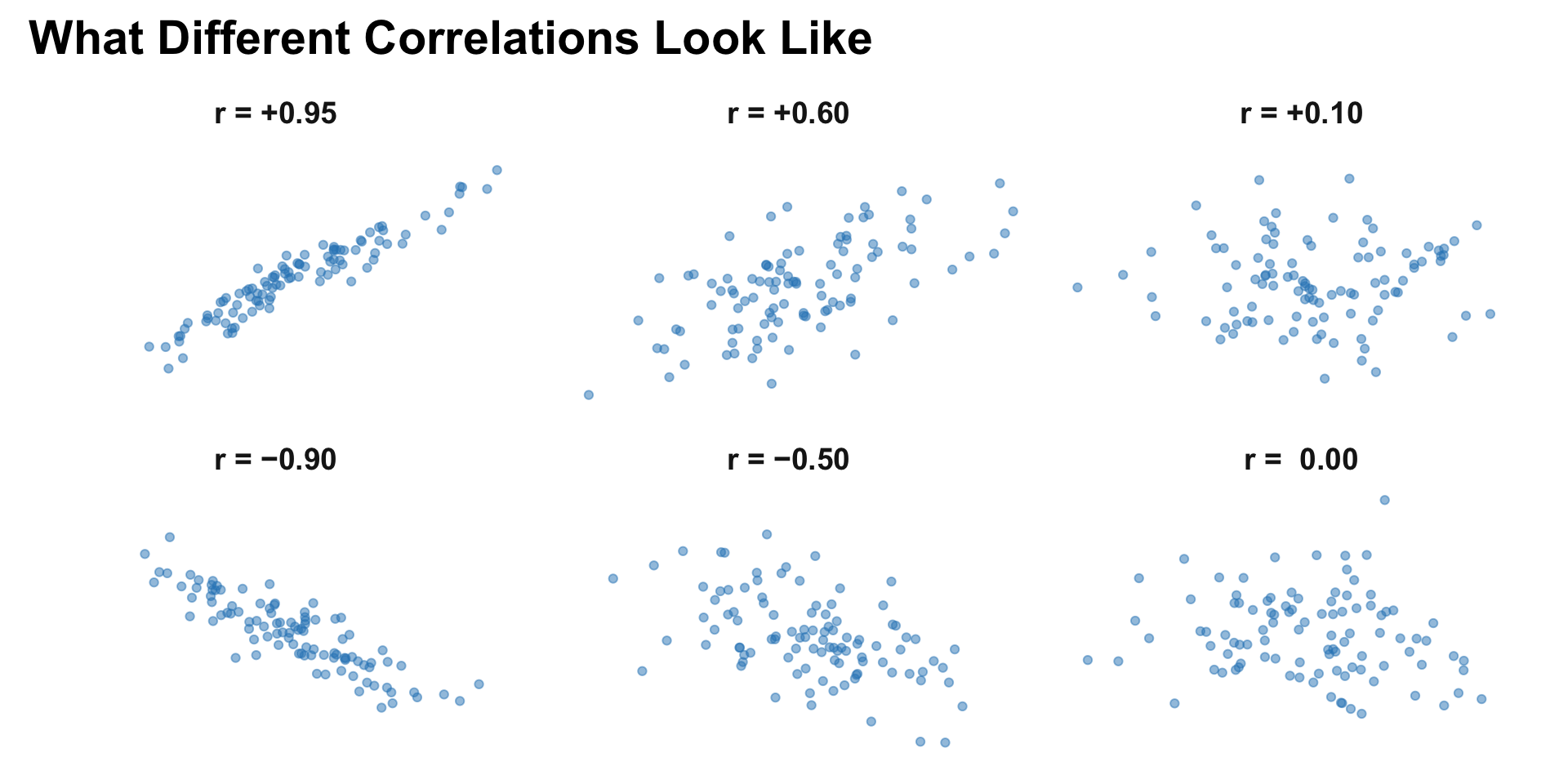
We can measure the strength and direction of a linear relationship with the correlation coefficient r.
\[r = \frac{1}{n-1}\sum_{i=1}^{n}\left(\frac{x_i - \bar{x}}{s_x}\right)\left(\frac{y_i - \bar{y}}{s_y}\right)\]
Properties of r:
- Always between −1 and +1
- r = +1: perfect positive linear relationship
- r = −1: perfect negative linear relationship
- r = 0: no linear relationship
- Sign tells us direction; magnitude tells us strength
Correlation: Visual Guide
![]()
For the penguins: Flipper length vs. body mass gives r = 0.87
Interpretation: Strong, positive linear relationship between flipper length and body mass.
⚠️ Correlation ≠ Causation
r = 0.87 means flipper length and body mass are strongly associated — but does longer flippers cause heavier penguins?
Possible explanations for an association:
- X causes Y (flipper length drives body mass)
- Y causes X (heavier penguins develop longer flippers)
- Lurking variable: a third variable drives both (e.g., age or species)
- Coincidence (unlikely with r = 0.87, but possible with small n)
Famous spurious correlations:
Think-Pair-Share #2
[Poll Everywhere — respond now!]
Researchers find that students who eat breakfast regularly have higher GPAs (r = 0.45, p < 0.001).
Discuss with your neighbor (2 min):
- Is this correlation positive or negative? Strong or weak?
- A journalist writes: “Eating breakfast improves academic performance.” Is this conclusion justified? What’s missing?
- Name one lurking/confounding variable that might explain this association without breakfast directly causing better grades.
→ Report your confounding variable on Poll Everywhere
Linear Regression
Correlation tells us how strongly two variables are related.
Regression gives us a line to describe or predict the response from the explanatory variable.
The least squares regression line minimizes the sum of squared residuals:
\[\hat{y} = b_0 + b_1 x\]
where:
- \(\hat{y}\) = predicted response
- \(b_0\) = y-intercept
- \(b_1\) = slope
For our penguins:
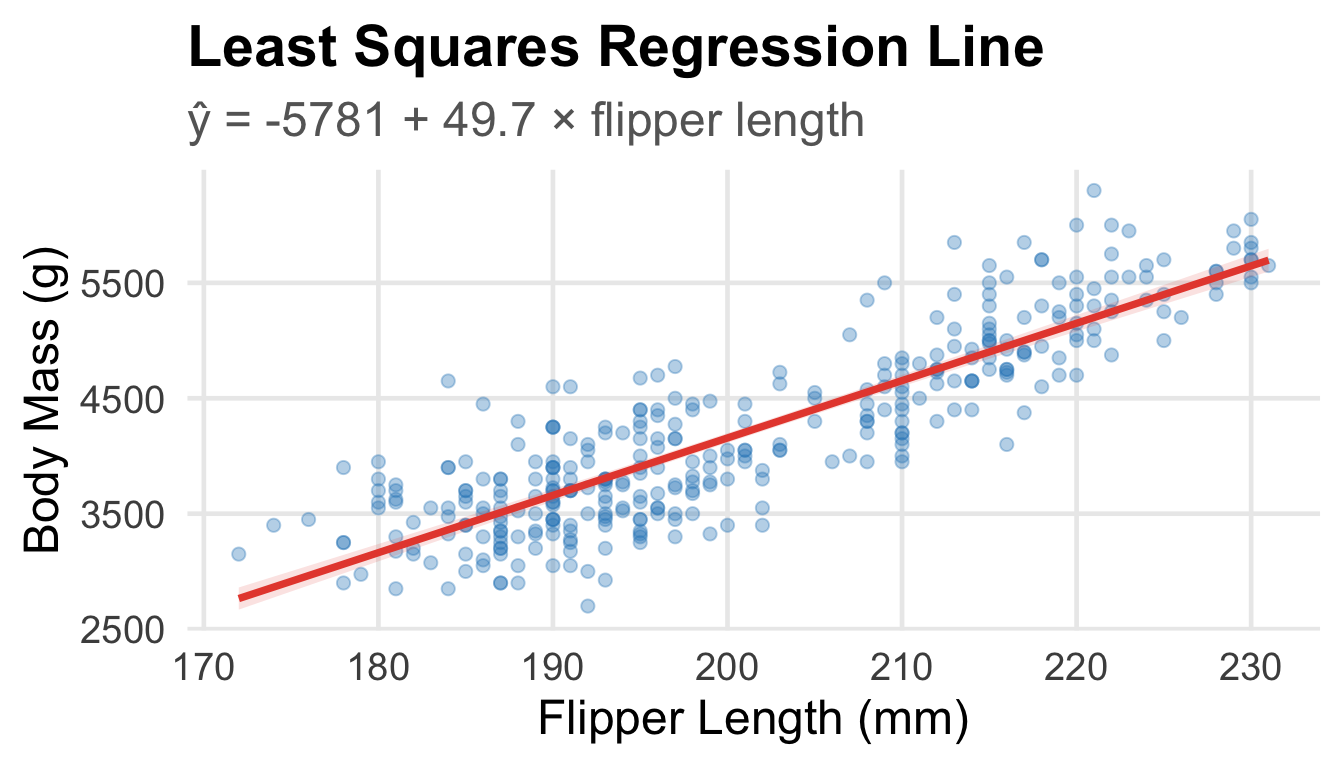
\[\widehat{\text{body mass}} = -5781 + 49.7 \times \text{flipper length}\]
Calculating the Regression Line
The least squares formulas for slope and intercept:
Slope:
\[b_1 = r \cdot \frac{s_y}{s_x}\]
where \(r\) is the correlation, \(s_y\) is the SD of the response, and \(s_x\) is the SD of the explanatory variable.
Intercept:
\[b_0 = \bar{y} - b_1 \bar{x}\]
The line always passes through the point \((\bar{x},\ \bar{y})\) — the means of both variables.
For our penguins:
\[b_1 = 0.87 \cdot \frac{802}{44} = 49.7 \text{ g/mm} \qquad b_0 = 4202 - 49.7 \times 200 = -5781 \text{ g}\]
Interpreting the Regression Line
![]()
Slope (b₁ = 49.7): For each additional 1 mm of flipper length, predicted body mass increases by 49.7 grams, on average.
Intercept (b₀ = -5781): A penguin with flipper length = 0 mm would be predicted to weigh -5781 grams — 🚨 not meaningful, just a mathematical anchor.
Making Predictions
\[\widehat{\text{body mass}} = -5781 + 49.7 \times \text{flipper length}\]
Example: A penguin has a flipper length of 200 mm. Predict its body mass.
\[\hat{y} = -5781 + 49.7 \times 200 = 4159 \text{ g}\]
⚠️ Extrapolation warning:
The penguin data ranges from flipper lengths of 172–231 mm.
Predicting for flipper = 100 mm or flipper = 300 mm is extrapolation — we have no data there and the linear pattern may not hold!
R Output: The Full Picture
Call:
lm(formula = body_mass_g ~ flipper_length_mm, data = penguins_clean)

Residuals:
     Min       1Q   Median       3Q      Max
-1058.80  -259.27   -26.88   247.33  1288.69

Coefficients:
                   Estimate Std. Error t value Pr(>|t|)
(Intercept)       -5780.831    305.815  -18.90   <2e-16 ***
flipper_length_mm    49.686      1.518   32.72   <2e-16 ***
---
Signif. codes:  0 '***' 0.001 '**' 0.01 '*' 0.05 '.' 0.1 ' ' 1

Residual standard error: 394.3 on 340 degrees of freedom
Multiple R-squared:  0.759, Adjusted R-squared:  0.7583
F-statistic:  1071 on 1 and 340 DF,  p-value: < 2.2e-16
What does R² = 0.759 tell us?
Interpreting R²
R² (R-squared) = the proportion of variability in the response variable explained by the model.
R² = 0.759 means:
75.9% of the variability in penguin body mass is explained by flipper length.
The remaining 24.1% is due to other factors (species, sex, diet, age, etc.)
Relationship to r:
\[R^2 = r^2 = (0.87)^2 = 0.7569 \approx 0.759\]
For simple linear regression, R² is literally the correlation squared!
☕ BREAK — 10 minutes
While you rest, think about:
We’ve predicted body mass from flipper length. But how well does our line actually fit? How do we check?
See you in 10!
Residuals: How Far Off Are We?
The residual for each observation is the difference between the actual and predicted values:
\[e_i = y_i - \hat{y}_i\]
Example:
- Penguin with flipper = 200 mm, actual body mass = 4800 g
- Predicted: \(\hat{y} = -5781 + 49.7(200) = 4159\) g
- Residual: \(e = 4800 - 4159 = 641\) g
A positive residual → actual value is above the line (we underpredicted)
A negative residual → actual value is below the line (we overpredicted)
The least squares line is chosen to make the sum of squared residuals as small as possible.
Residual Plots: Checking the Model
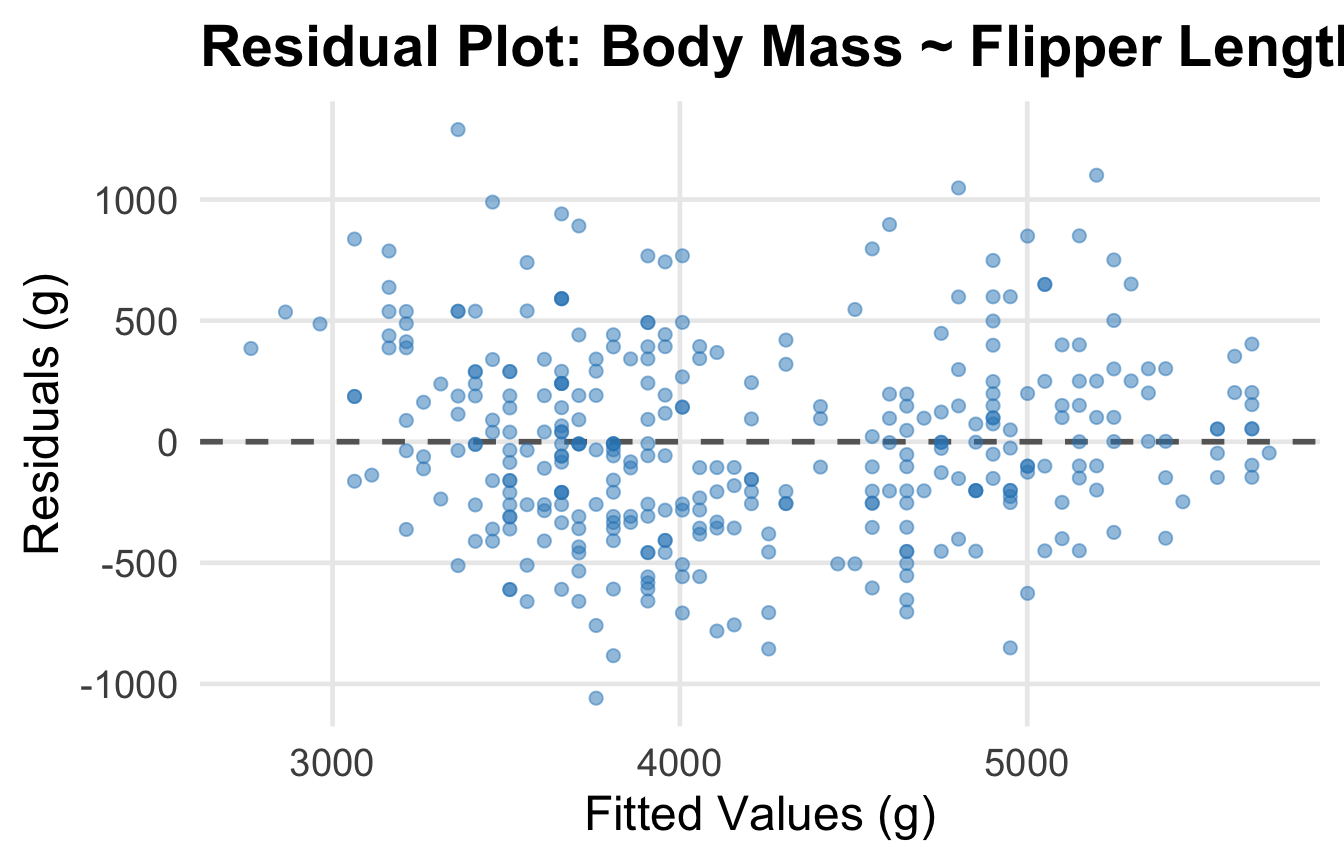
To check whether a linear model is appropriate, we plot residuals vs. fitted values.
![]()
What we want to see: No pattern — random scatter around zero.
Reading Residual Plots
✅ Good: Random scatter around zero
→ Linear model is appropriate; constant variance
❌ Problem: Curved pattern
→ The relationship is not truly linear; consider transformations
❌ Problem: Fan shape (variance increases)
→ Constant variance assumption is violated
❌ Problem: Outliers (one or two extreme points)
→ Investigate those observations carefully
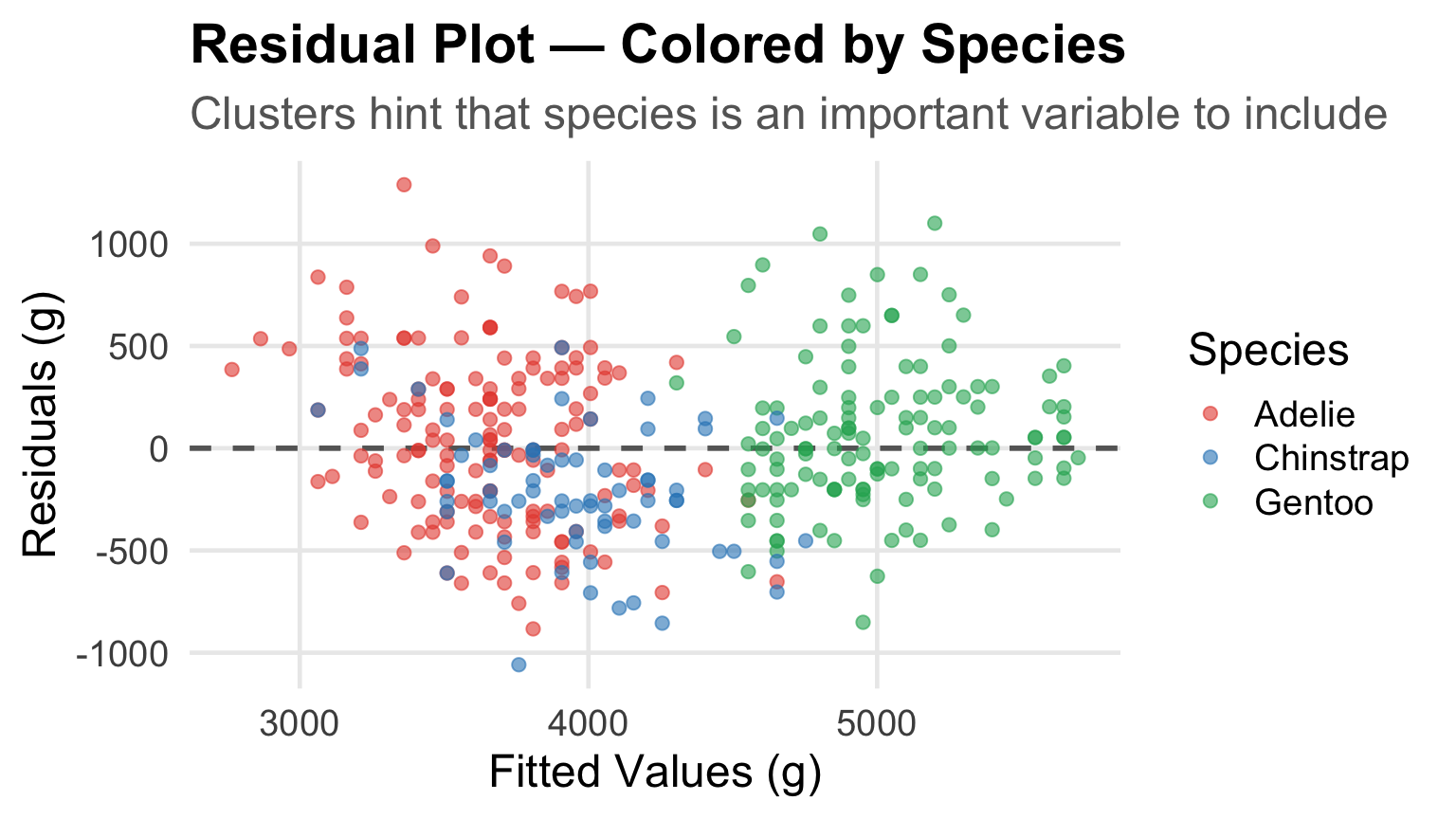
Residual Plot for Penguins
![]()
Interpretation: Clusters by species reveal that mixing three species creates structure in the residuals — species is a lurking variable!
Think-Pair-Share #3
[Poll Everywhere — respond now!]
A researcher fits a linear regression of plant height (cm) on amount of fertilizer (g). The residual plot shows a clear U-shaped curve.
Discuss with your neighbor (2 min):
- What does this U-shape in the residual plot tell us?
- Is the linear model appropriate here? What would you recommend?
- In the penguin data, we noticed clusters in the residual plot. What variable might be creating these clusters?
→ Report your answer to Q3 on Poll Everywhere
Conditions for Linear Regression
For regression to be valid (especially for inference), we need:
Linearity — the relationship between x and y is linear (check scatterplot)
Independence — observations are independent of each other (study design)
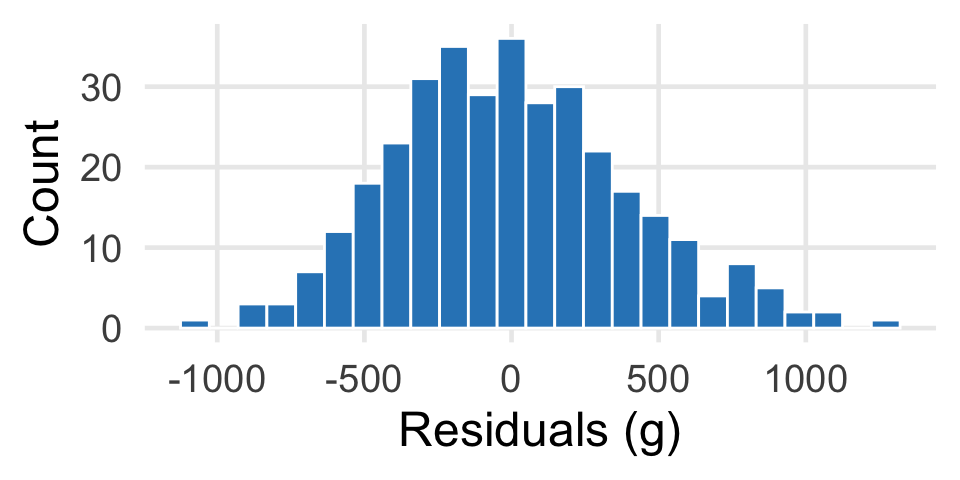
Normal residuals — residuals are approximately normally distributed (check histogram of residuals)
Equal variance — residuals have roughly constant spread (check residual plot)
Remember the acronym: LINE
Today’s Summary
Scatterplots visualize the relationship between two numerical variables — describe direction, form, strength, and outliers
Correlation (r) quantifies linear association: ranges from −1 to +1
Correlation ≠ Causation — association could be due to lurking variables
Regression line (\(\hat{y} = b_0 + b_1 x\)) predicts the response from the explanatory variable
Slope: change in predicted ŷ per 1-unit increase in x; Intercept: predicted ŷ when x = 0
R²: proportion of variability in y explained by the model
Residual plots: check for linearity and equal variance assumptions
Looking Ahead: Thursday
Next class we cover:
- Outliers and influential points — what happens when we have unusual observations?
- Regression inference — testing whether the slope is really different from zero
- Reading full R output for regression
- ANOVA — comparing means across three or more groups
The penguins will be back! We’ll compare bill length across all three species.