STAT 7: Statistical Methods for the Biological, Environmental, and Health Sciences
01 Dec 2025
The 95% That Changed the World
In 2020, Pfizer announced their COVID-19 vaccine was “95% effective”
The impact? This single statistical measure helped save millions of lives and end global lockdowns
The tool? Statistics and clinical trial analysis
Every Scientific Discovery is a Statistical Discovery
- Medicine: Does this treatment work? → Clinical trials & hypothesis testing
- Environmental Science: Is climate change accelerating? → Time series analysis
- Biology: Which genes correlate with disease risk? → Regression & correlation
- Public Health: Should we mandate this vaccine? → Risk-benefit analysis & probability
Every Scientific Discovery is a Statistical Discovery
You’re not just learning formulas—you’re developing the critical thinking skills needed to understand scientific evidence and make informed decisions about health, environment, and life itself.
Why Statistics Matter for YOUR Future
🔬 Future Scientists & Health Professionals
- Every medical breakthrough relies on statistical evidence
- Clinical trials, drug development, disease surveillance
- Environmental monitoring, conservation biology, epidemiology
- Understanding research papers and evaluating medical claims
🧠 Problem-Solving Skills
- Critical thinking: Evaluate scientific claims and research
- Pattern recognition: Identify trends in biological and health data
- Risk assessment: Understand health risks and environmental impacts
- Communication: Explain scientific findings to diverse audiences
🚀 Your Competitive Edge
Whether you’re heading to med school, grad school, public health, environmental consulting, or biotech—you’ll be the person who truly understands what the data is saying
Meet Your Teaching Team 👋
Your instructor
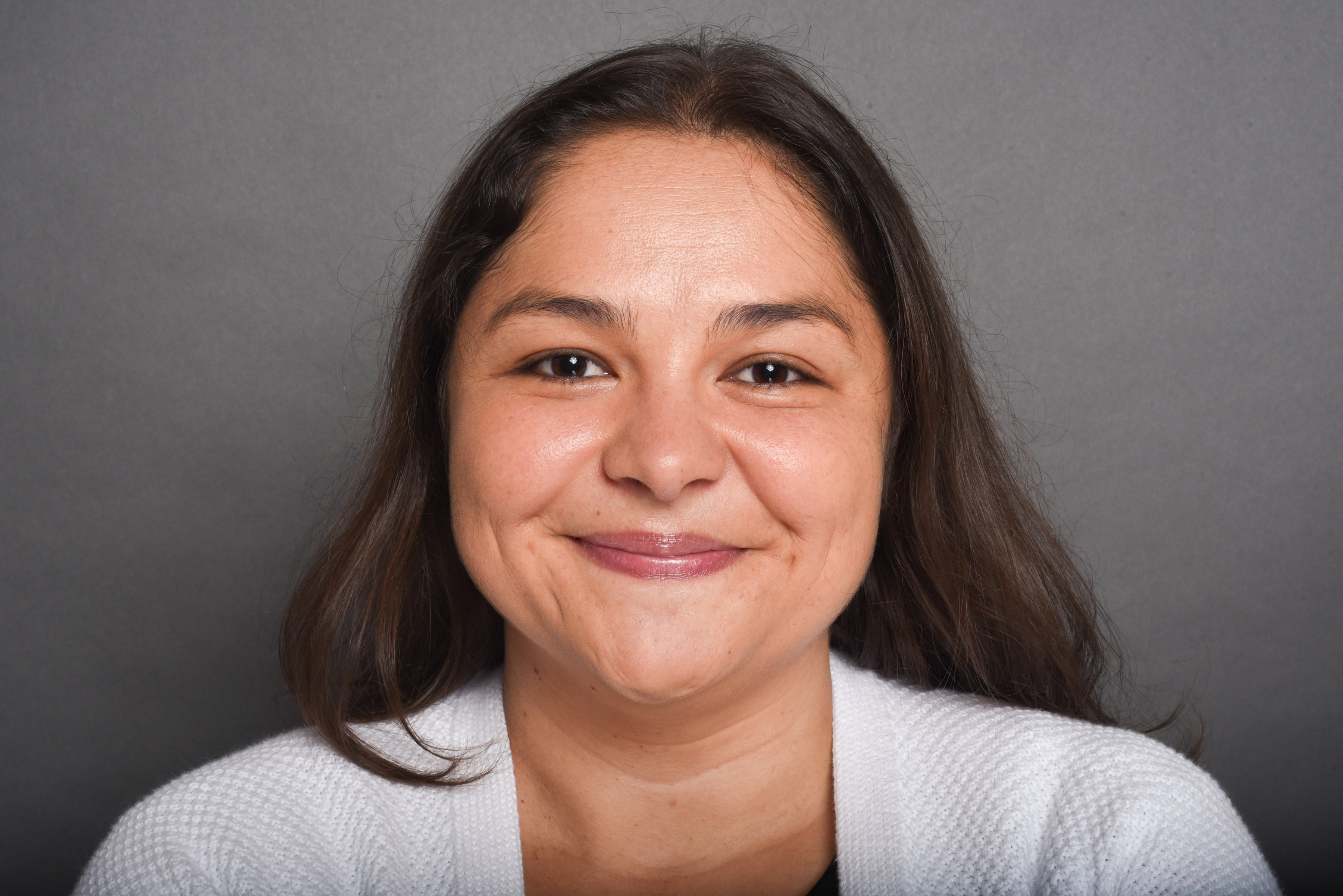
Associate Professor of Teaching - Statistics
Stats & Data Science Educator and Education researcher
Applied statistician (environmental & biological problems)
- 🍃 15+ years teaching statistics
- Background: Statistical & Data Science Education + Applied Stats
- Originally from Costa Rica 🌊
- Pronunciation: [mahr-sahl-ah]
R programming
stats
environmental statistics
biological data analysis
open and reproducible science
Office Hours = Student Hours!
📅 When Can You Find Me?
In Person: - After EVERY class (Tu & Th, starting ~6:55 PM) - Right outside the classroom - stay and chat!
By Appointment: - Check my Google Calendar for available times - If you cannot find a time, post on Ed Discussion to request extra OH.
💡 Pro tip: Don’t wait until you’re struggling! Come early and often. Office hours are YOUR time to:
- Clarify concepts
- Review homework before it’s due
- Discuss study strategies
- Ask “silly” questions (there are none!)
Your Teaching Team

Yongqi Chen
PhD Student
Section C on Mondays
ychen574@ucsc.edu

Elizabeth Hudson
PhD Student
Sections D and E on Wednesdays
erhudson@ucsc.edu

Vikram Srinivasan
PhD Student
Sections A and B on Fridays
vicsrini@ucsc.edu
+ Readers: Misha Tran Burton, Ingrid Eliza Fowler-White, Evelyn Ruedas
+ LSS tutors: Sharry Eydel seydel@ucsc.edu
Communication
📢 How to Reach Us
Option 1: Ed Discussion (BEST!)
- Post questions about course content, assignments, logistics
- Answered same day during weekdays
- Weekends: expect response by Monday
- Your classmates can help too!
- Remember you can use the private setting in Ed Dicussion for private matters.
Option 2: Email
- Response time: 2-3 business days
- Not recommended for urgent matters! my inbox get really clogged every day.
⚡ Quick response = Ed Discussion | Please don’t use Canvas messages, you will get an automatic reply telling you to go to Ed
Your turn!
- First, introduce yourself to at least 3 of your neighbors.
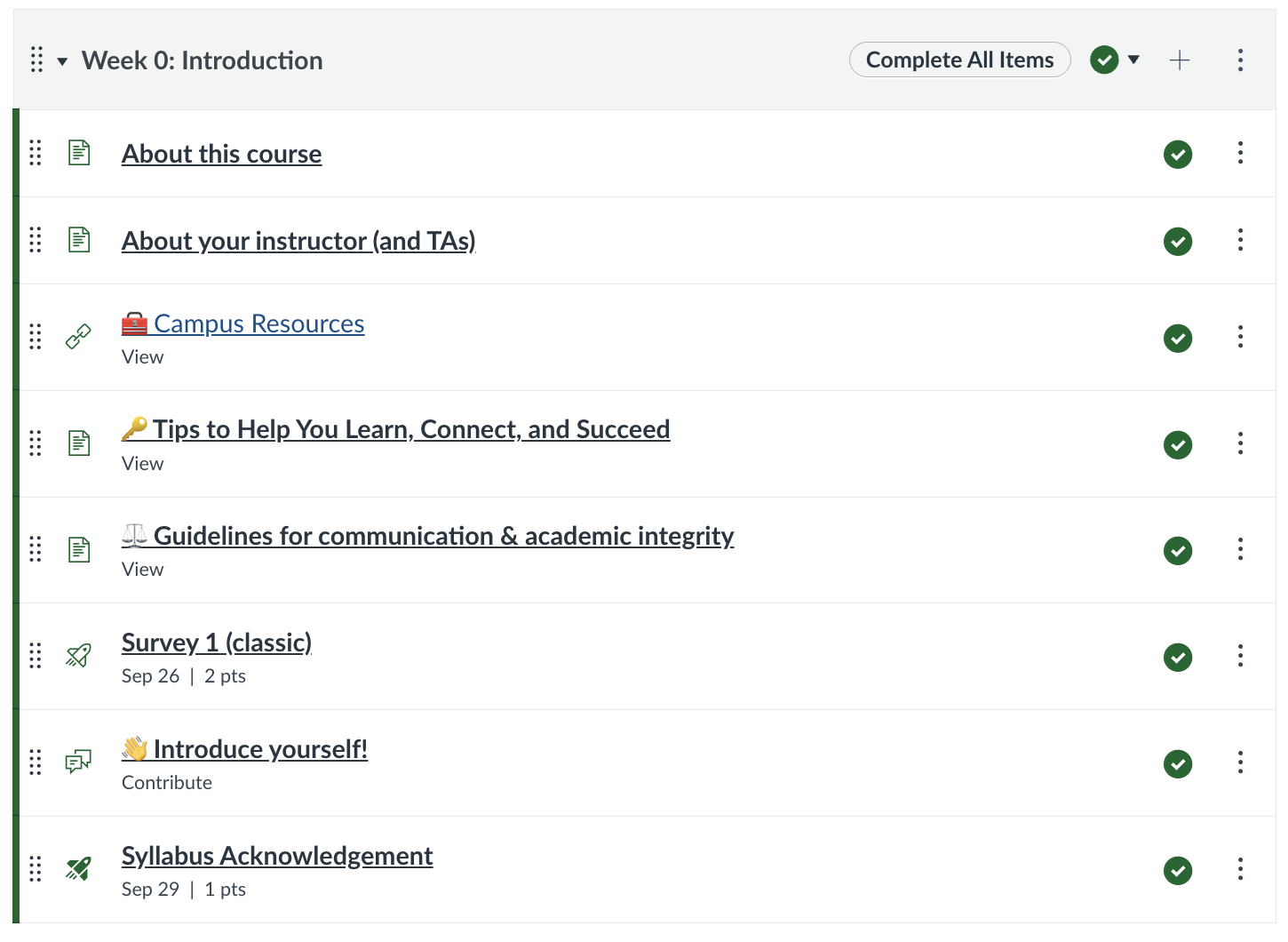
- Then, if you haven’t, go to Canvas and check all Week 0
- Complete Survey 1 and the syllabus acknowledgement.
LSS

Course Essentials 📋
Canvas - Your Course Hub
📚 What You’ll Find:
- Modules: Weekly materials organized by topic
- Lecture slides: Posted before each class
- Assignments: Homework & worksheets with due dates
- Grades: Track your progress
- Ed Discussion: Link to Q&A forum, messaging the teaching team, and announcements
🎯 Weekly Routine:
- Check the materials page
- Review lecture slides
- Complete assigned readings
- Work on homework/worksheets
- Prepare for discussion section
📌 Bookmark Canvas! Check it at least 3 times per week to stay on track
Required Materials
📚 Textbook (FREE!)
Introductory Statistics for the Life and Biomedical Sciences by Julia Vu and Dave Harrington
Free PDF & Printed version ($21)
💻 Technology
- Laptop/desktop computer
- Google Suite access
- Poll Everywhere (I’ll cover the cost!)
📍 Class Logistics
When: TuTh 17:20-18:55
Where: Thim Lecture 003
Lab: STAT 7L (separate course, concurrent enrollment required)
Communication:
1. Ed Discussion (best option!)
2. Email (2-3 day response time)
Grade Breakdown
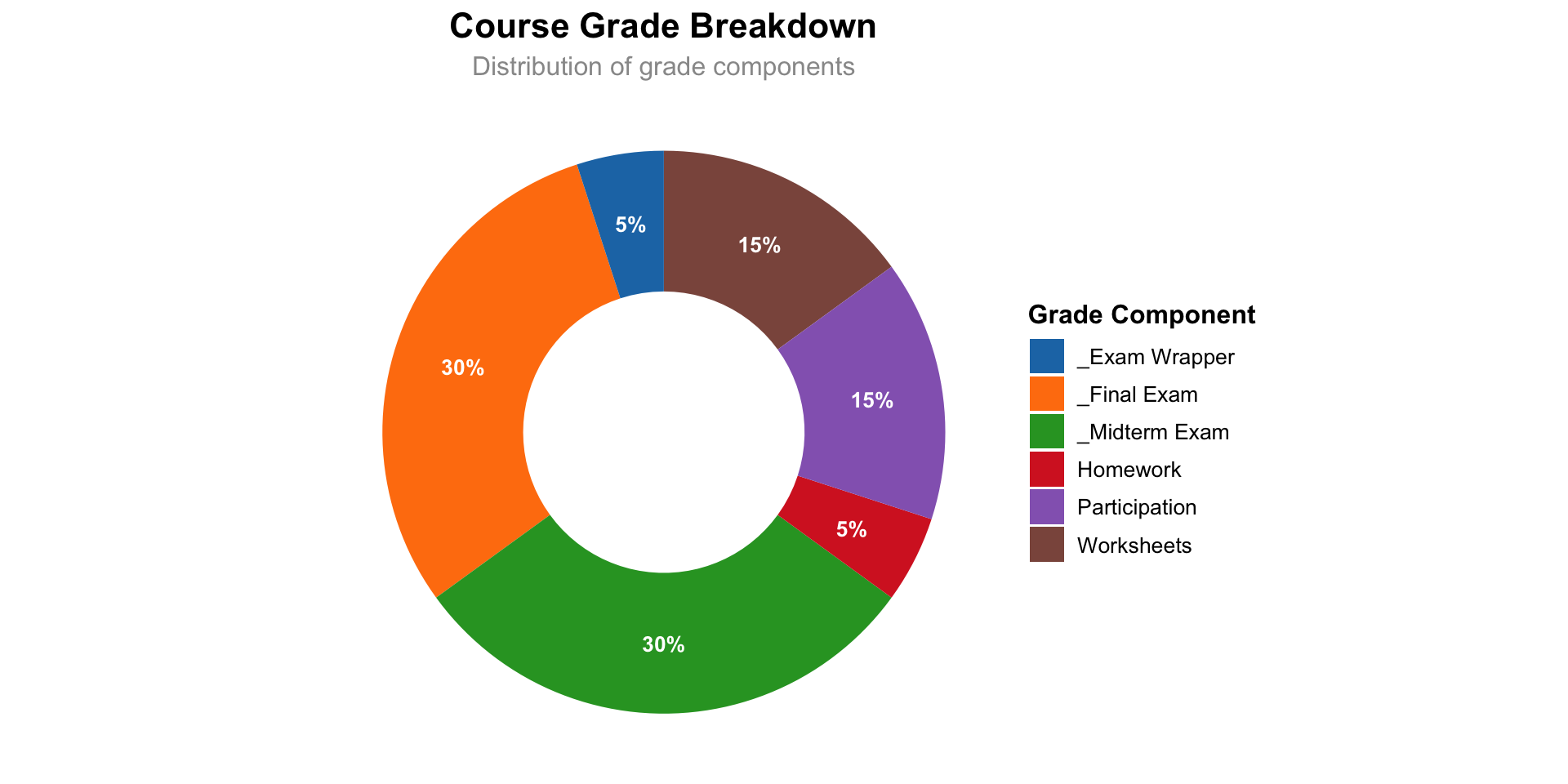
| Component | Percentage | Details |
|---|---|---|
| Final Exam | 30% | Wed 3/18, 7:30-9:30 PM |
| Midterm Exam | 30% | Th 2/05 in class |
| Worksheets (DSAs) | 15% | 9 total, only top 5 count |
| Homework | 5% | 8-9 total, only top 5 count |
| Participation | 15% | Attendance + engagement |
| Exam Wrapper | 5% | Reflection assignment |
Grade Breakdown
Assignments Overview
📝 Homework (5%)
- 8-9 assignments across the quarter
- Only top 5 count toward your grade
- Completion-based grading
- 1 week to complete each
- Late policy: -1 point/day (closed after 1 day)
🎯 Purpose:
Practice concepts at your own pace
📊 DSAs (15%)
- 9 worksheets total
- Only top 5 count toward your grade
- Completed in discussion sections
- Pair work encouraged
- Must attend section to receive credit
🎯 Purpose:
Collaborative problem-solving practice
💡 Strategy tip: Since only your top 5 count for each, you can miss 3-4 assignments and still get full credit! But don’t rely on this—use them all as learning opportunities.
Grade Scale
| Letter | Score | Letter | Score |
|---|---|---|---|
| A+ | x ≥ 99 | C+ | 70 ≤ x < 74.99 |
| A | 95 ≤ x < 98.99 | C | 65 ≤ x < 69.99 |
| A- | 90 ≤ x < 94.99 | C- | 60 ≤ x < 64.99 |
| B+ | 85 ≤ x < 89.99 | D | 50 ≤ x < 59.99 |
| B | 80 ≤ x < 84.99 | F | x < 50 |
| B- | 75 ≤ x < 79.99 | P/NP | x ≥ 65 / x < 65 |
The Rules That Matter Most
✅ Attendance & Flexibility
- 85% attendance to lecture counts as perfect attendance
- Discussion sections mandatory for DSA credit
- All exams in-person only
📝 Assignments
- Homework: completion-based, 1 week to complete. Only top 5 count.
- DSAs: pair work in discussion sections, in-person only. Only top 5 count.
- Late penalty: -1 point per day. Closed after 1 day.
The Rules That Matter Most
🤖 AI Policy
For studying: ✅ Create practice problems, explain concepts
For graded work: ❌ No AI assistance on homework, DSAs, exams
Why? You need to build these neural pathways yourself!
🎯 Success Tips
- Read textbook weekly
- Attend office hours early & often
- Form study groups
- Build formula sheets as you go
Discussion Sections & Attendance
🎓 Why Discussion Sections Are Mandatory
You’ll Learn Better:
- Work through problems with peers
- Get immediate feedback from TAs
- Practice applying lecture concepts
- Ask questions in a smaller setting
Build Your Study Network:
- Meet classmates in your section
- Form study groups organically
- Work in pairs on worksheets
- Learn from each other’s approaches
📊 Remember: You have 9 DSAs, but only your top 5 count. This gives you flexibility for sick days or conflicts while still rewarding consistent attendance!
Academic Integrity
What’s Expected
- Submit your own work on all graded assignments
- Proper citations when using external sources
- No sharing of exam content
- Ask questions if you’re unsure about the rules
What’s Not Allowed
- Using AI tools for homework/worksheets/exams
- Copying from classmates or online sources
- Sharing exam questions with future students
- Self-plagiarism from other courses
Let’s test Poll Everywhere
Write ONE word you associate with statistics in science
What is Statistics?
“Statistics is the practice or science of collecting and analyzing numerical data in large quantities, especially to infer proportions in a whole from those in a representative sample.”
— Oxford Languages
In this class, you’ll learn:
- How to collect meaningful data
- How to analyze and interpret patterns
- How to make inferences about populations
- How to communicate statistical evidence
What You’ll Master This Quarter
- Describe data effectively → Summarize health and biological datasets
- Understand probability → Assess disease risk and genetic outcomes
- Master sampling & estimation → Design studies and estimate population parameters
- Hypothesis testing → Test scientific claims about treatments and interventions
- Regression analysis → Understand relationships between biological/health variables
- Real-world applications → Analyze actual data from medicine, biology, and environmental science
Tools: Google Sheets (in class) + R (in STAT 7L) ← separate course
STAT 7L and STAT 7
📊 STAT 7 (this class)
- Focus: Statistical concepts and theory
- Tool: Google Sheets for calculations
- Format: Lectures + discussion sections
- Emphasis: Understanding WHY methods work
💻 STAT 7L (lab course)
- Focus: Statistical software
- Tool: R and JAMOVI
- Format: Hands-on lab activities
- Emphasis: HOW to implement methods
🔗 How They Connect:
- Same statistical concepts, different tools
- STAT 7L gives you practical computing skills
- Both required for complete understanding
- Coordinate your study time for both courses
Note: You’ll work with your STAT 7L instructor on R/JAMOVI specifics. Different instructor, complementary content!
Exit Ticket
Before you leave today:
✅ Complete Module 0 on Canvas (if you haven’t already)
✅ Two assignments due THIS WEEK:
- Syllabus Acknowledgement (1 point)
- Survey 1 (2 points)
✅ Join Ed Discussion (link on Canvas)
✅ Download/access the textbook
✅ Check your discussion section time and location
⏰ Due dates: Check Canvas for specific deadlines. Both assignments count toward your grade!
Discussion Sections (Start Next Week!)
| Section | Day/Time | Location | TA |
|---|---|---|---|
| STAT 7-01A | Friday 8:00-9:05 AM | Engineer 2 192 | Vikram Srinivasan |
| STAT 7-01B | Friday 9:20-10:25 AM | PhysSciences 136 | Vikram Srinivasan |
| STAT 7-01C | Monday 4:00-5:05 PM | Crown Clrm 208 | Yongqi Chen |
| STAT 7-01D | Wednesday 7:10-8:15 PM | Kresge Acad 3101 | Elizabeth Hudson |
| STAT 7-01E | Wednesday 2:40-3:45 PM | Oakes Acad 106 | Elizabeth Hudson |
Final Thoughts
You’re about to develop one of the most valuable skill sets for understanding science and health
- Statistics isn’t just math—it’s the language of scientific evidence
- Every medical discovery, environmental policy, and biological breakthrough relies on these skills
- You’ll leave this class able to: read research papers critically, evaluate health claims, understand scientific debates
Questions? Office hours start next week, or catch me after class today.
Welcome to STAT 7!
Let’s discover what the data reveals about our world 🌍🔬

STAT 7 – Winter 2026