STAT 17: Linear Regression
Prof. Marcela Alfaro Cordoba
Statistics - UCSC
25 Nov 2025
📊 Case Study: TechStart Ventures
TechStart Ventures is a venture capital firm evaluating startup investments. They’ve noticed that advertising spending seems related to revenue, but they need a systematic way to:
- Quantify the strength of relationships between variables
- Predict future revenue based on planned advertising budgets
- Make decisions about which startups show the strongest revenue-to-marketing relationships
Today: Learn how correlation and linear regression can transform scattered data points into actionable business insights!
Learning Objectives 🎯
By the end of today’s lecture, you will be able to:
- Understand and interpret scatterplots to visualize relationships
- Calculate and interpret the correlation coefficient (r)
- Develop and interpret simple linear regression equations
- Understand what regression coefficients (slope and intercept) mean
- Make predictions using regression equations
- Use Google Sheets for correlation and regression analysis
Why Linear Regression is Essential
📈 Descriptive Statistics
Summarize relationships: How strong is the association between advertising and revenue?
Quantify direction: Does the relationship increase or decrease?
Visualize patterns: See trends in your data clearly
🔮 Inferential Statistics
Make predictions: Forecast revenue for new advertising budgets
Test hypotheses: Is this relationship statistically significant?
Quantify uncertainty: How confident are we in our predictions?
Regression is the bridge between description and prediction!
Scatterplots: The Foundation
![]()
What to look for:
- Direction: Positive or negative?
- Form: Linear or curved?
- Strength: Tight cluster or scattered?
- Outliers: Unusual points?
THINK-PAIR-SHARE 1 (5 minutes)
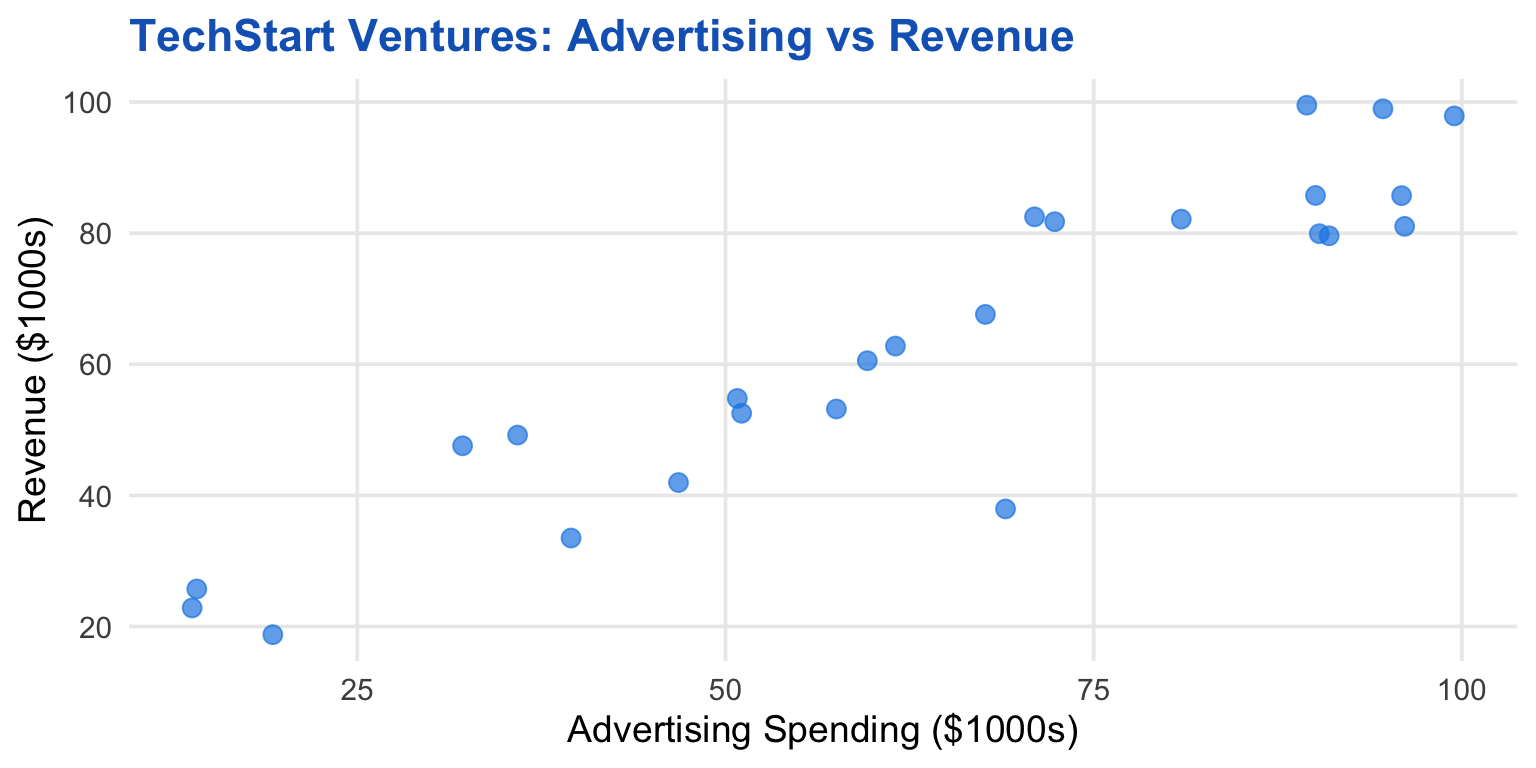
Looking at the scatterplot on the previous slide:
What best describes the relationship between advertising and revenue?
A. Strong positive linear relationship
B. Weak positive linear relationship
C. No relationship
D. Negative linear relationship
![]()
Part 2: Quantifying Relationships 📏
The Correlation Coefficient
Correlation Coefficient (r)
Measures the strength and direction of a linear relationship
Formula (you won’t calculate by hand!)
\[r = \frac{\sum (x_i - \bar{x})(y_i - \bar{y})}{\sqrt{\sum(x_i - \bar{x})^2 \sum(y_i - \bar{y})^2}}\]
Range: \(-1 \leq r \leq +1\)
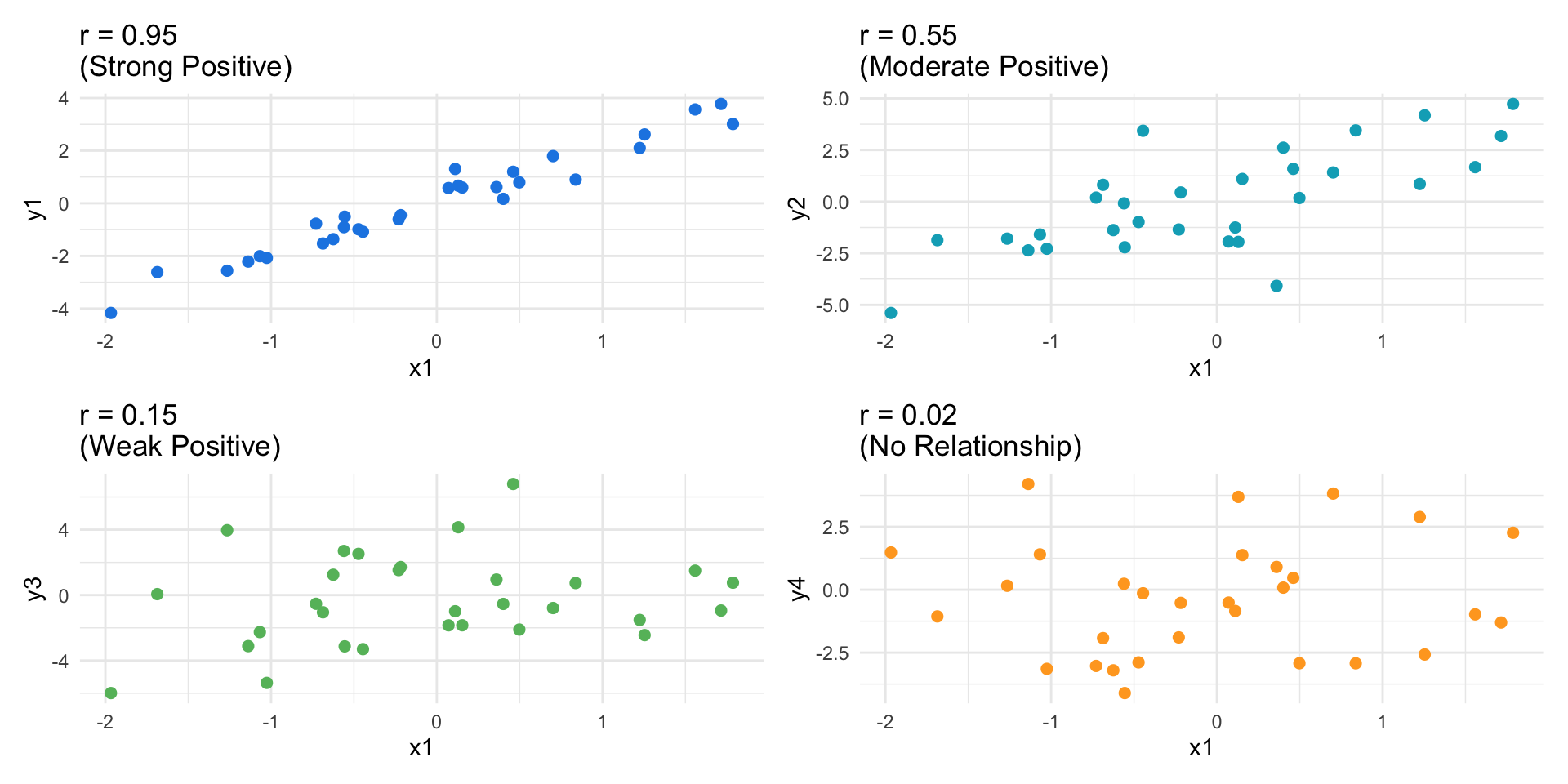
Interpretation Guidelines:
| 0.0 - 0.3 |
Weak |
| 0.3 - 0.7 |
Moderate |
| 0.7 - 1.0 |
Strong |
For TechStart data: \(r = 0.85\) → Strong positive linear relationship!
Understanding Correlation Values
![]()
⚠️ Correlation ≠ Causation! High correlation doesn’t mean one variable causes the other.
THINK-PAIR-SHARE 2 (7 minutes)
A study finds r = -0.68 between hours of study and test anxiety.
What does this mean?
A. More study causes less anxiety
B. Less study causes more anxiety
C. There’s a moderate negative relationship
D. There’s no relationship
![]()
🍵 Break Time!
We’ll return to build regression equations and make predictions!
Part 3: Simple Linear Regression 📐
Building Prediction Equations
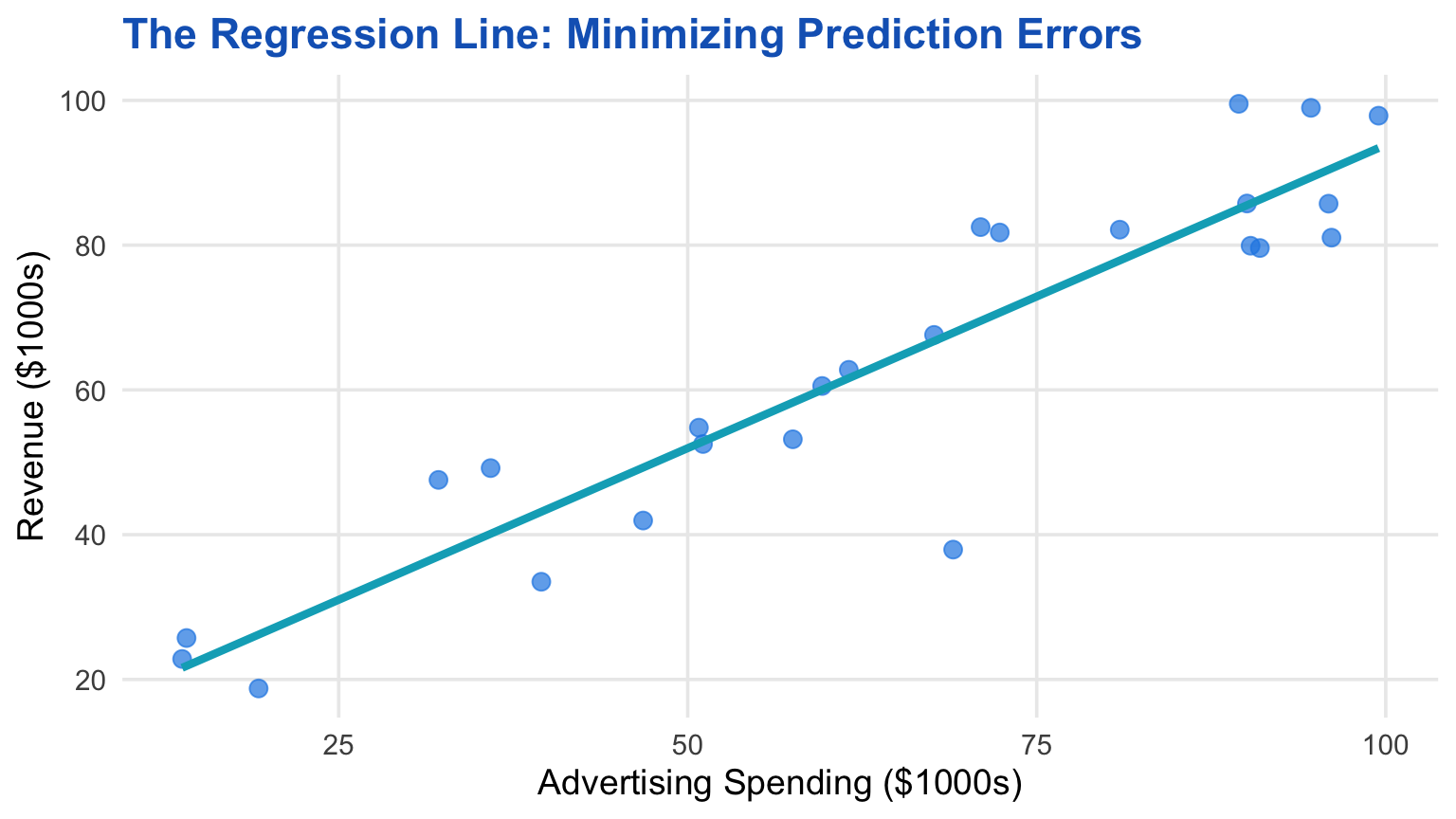
The Regression Line: “Line of Best Fit”
![]()
Goal: Find the line that minimizes the sum of squared errors (vertical distances from points to line)
This is called the Least Squares Regression Line
The Regression Equation
\[\widehat{y} = b_0 + b_1 x\]
Where:
- \(\widehat{y}\) (y-hat) = predicted value of y
- \(b_0\) = y-intercept (value of y when x = 0)
- \(b_1\) = slope (change in y for each 1-unit increase in x)
- \(x\) = value of the explanatory variable
For TechStart Ventures
\[\widehat{\text{Revenue}} = 12.45 + 0.78 \times \text{Advertising}\]
- Intercept (12.45): Expected revenue with $0 advertising is $12,450
- Slope (0.78): For each $1,000 increase in advertising, revenue is expected to increase by $780
Understanding the Slope
The slope (\(b_1\)) is the most important coefficient!
\[b_1 = r \times \frac{s_y}{s_x}\]
Where:
- \(r\) = correlation coefficient
- \(s_y\) = standard deviation of y
- \(s_x\) = standard deviation of x
The slope combines: 1. Correlation (how strong is the relationship?) 2. Relative variability (how much does y vary compared to x?)
For TechStart: \(b_1 = 0.85 \times \frac{18.2}{19.7} = 0.78\)
Making Predictions or Estimations
Example: A startup plans to spend $50,000 on advertising. What revenue do we predict?
Step 1: Identify the regression equation
\[\widehat{\text{Revenue}} = 12.45 + 0.78 \times \text{Advertising}\]
Step 2: Substitute x = 50
\[\widehat{\text{Revenue}} = 12.45 + 0.78 \times 50 = 12.45 + 39 = 51.45\]
Step 3: Interpret in context
We predict this startup will generate approximately $51,450 in revenue.
⚠️ Extrapolation warning: Only make predictions within the range of your data!
THINK-PAIR-SHARE 3 (7 minutes)
Using the TechStart regression equation:
\(\widehat{\text{Revenue}} = 12.45 + 0.78 \times \text{Advertising}\)
If advertising spending is $30,000, what revenue do we predict?
A. $24,850
B. $35,850
C. $42,450
D. $51,450
![]()
Residuals: Prediction Errors
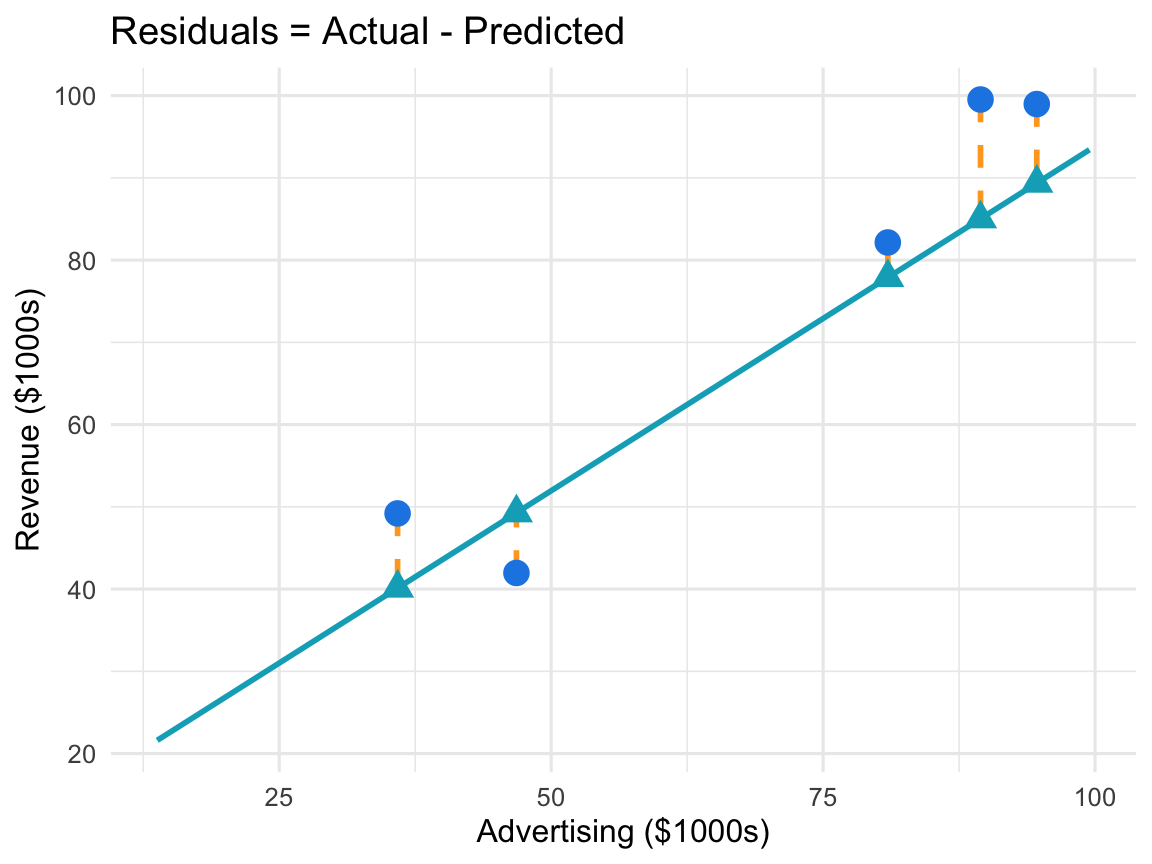
Residual: The difference between actual and predicted values
\[e = y - \widehat{y}\]
Properties:
- Positive: Actual > Predicted
- Negative: Actual < Predicted
- Sum of residuals = 0
- Used to assess model fit
Good model: Small residuals
R-squared: “Goodness of Fit”
How much of the variability in y is explained by x?
\[R^2 = r^2\]
\[R^2 = (0.85)^2 = 0.72 = 72\%\]
Interpretation: 72% of the variability in Revenue is explained by Advertising spending.
Guidelines:
| 0.00 - 0.30 |
Weak fit |
| 0.30 - 0.70 |
Moderate fit |
| 0.70 - 1.00 |
Strong fit |
The remaining 28% is due to other factors (product quality, market timing, competition, etc.)
THINK-PAIR-SHARE 4 (7 minutes)
A regression model has \(R^2 = 0.40\).
What does this mean?
A. The correlation coefficient is 0.40
B. 40% of variability in y is explained by x
C. The model makes 40% errors
D. We’re 40% confident in predictions
Looking Ahead: Next Lecture Preview
Next week: Inference with Regression
- Is the relationship statistically significant?
- Hypothesis tests for slope (is \(b_1 \neq 0\)?)
- Confidence intervals for predictions
- Standard error and prediction uncertainty
- Conditions for regression inference
We’ll shift from describing relationships to making inferences about populations based on sample data!
Questions? 💭
What questions do you have about:
- Scatterplots?
- Correlation?
- Regression equations?
- Making predictions?
- Using Google Sheets?
Thank You! 🎉
See you next time for:
Inference with Regression
Office hours I’ll be here after class in case you need to talk